Archive

Tag Archives: wooden boats

Aligning stations with a simple laser-level is easy.

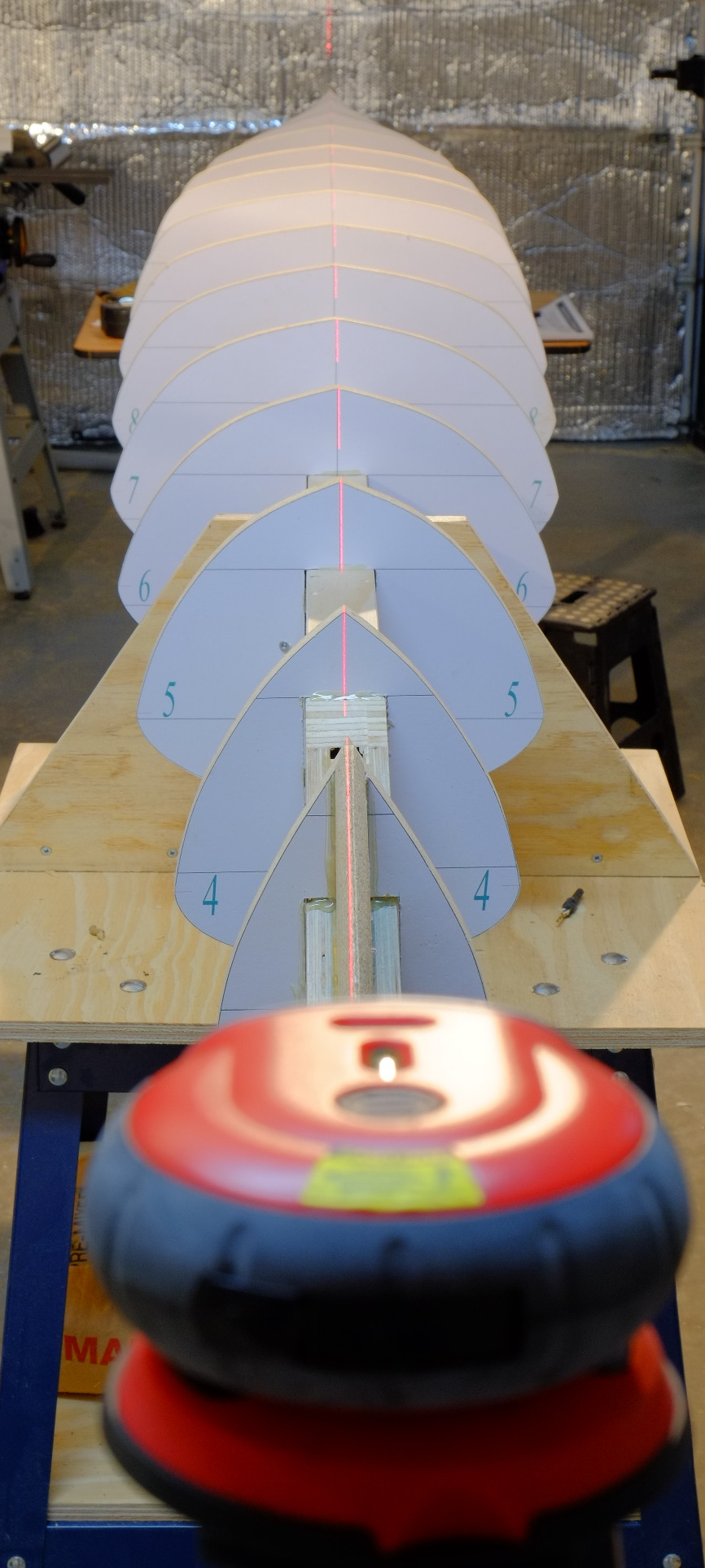
Aligning stations with a simple laser-level is easy.

A friend introduced me to kayaking last year and quickly got me hooked. I decided to build one over the winter and I will report progress from time-to-time and pass on any useful building tips.

A few trips on local lakes convinced me that I wanted my own kayak and subsequent research revealed that choosing one wasn’t as easy as it first seemed. There are always design compromises and in an ideal world one would have a selection of kayaks and chose according to the whim of the moment or the task in hand. I wanted it all; speed, stability, lightness, durability, seaworthiness and carrying capacity all in the same boat but as with other areas of life, compromises would be needed.

I got off to a false start when I purchased plans for a simple, 16’ stitch and glue design from a well known supplier. I soon realized that I had chosen a design which I would quickly outgrow. Although stable and predictable, it was probably going to be slow, so I set aside the plans and resumed my search, eventually settling on the Storm LT by One Ocean Kayaks. It is narrow (21.5” beam) and has a 16’ 3” L.O.A. with graceful, upswept ends. The Storm LT is actually a smaller version of the designer Vaclav Stejskal’s Cape Ann Storm and should be a good match for my 150 lb weight. For a novice its narrow beam may be a bit of a challenge and I hope that I haven’t bitten off more than I can chew. Fortunately, the designer claims good secondary stability which is comforting for someone who loves being on the water not in it.

The plans and manual for this strip-planked boat were beautifully done and there seems to be a plethora of advice available on-line with step-by-step building photographs and tips. There is also a wealth of hydrodynamic data which instills confidence.

So why build when there are plenty of production boats available, some little more expensive than the cost of materials for this strip-planked design? Well, it quickly became clear that a kayak is a boat that you slip-on and wear. It has to be a good fit, in terms of body weight and size, otherwise performance and comfort will suffer. Production boats are available in limited sizes.

In selecting a custom design, I felt that I could get close to the optimum boat for my weight and build. Not only that, I would have the lightest possible boat – important when loading onto a roof-rack or carrying up a beach. Indeed, the Storm LT should weigh less than a carbon-fiber production boat of similar size. Aesthetically, the strip-plank boat also wins hands-down.

I was once helped build a 36’ strip-cedar catamaran. I haven’t used this technique since and wanted to give it another try.

Building the mould was fairly straight forward, except that the plywood spine, built as a box beam, wasn’t perfectly true. I used an inexpensive laser level to check the alignment against convenient datum lines on the stations and made the appropriate adjustments using wedges and other methods of persuasion. The plans suggest using saw horses to support the mold but I opted for a couple of inexpensive metal stands designed for chop-saws or drill presses. These were “ballasted” with heavy items to keep them firmly in position. Now I have a fair mould.

I’m using ¼” red cedar, sawn from clear 16’ boards. I’m not using bead and cove molding but will use a block plane to fit each strip individually. I am using Titebond Polyurethane glue because the squeeze-out turns to foam, making clean-up really easy.

All well and good in theory but I will let you know how it works in practice. Stay tuned!

2cac9d6d5b3309f676fe655baa5b58543ad6525a-thumbBy David Skelhon

Thirty years ago I quit my job in science and engineering. Even in my late 20’s I was tired and disgruntled with the world and my place in it. I wanted to get off the treadmill, and experience the beauty of Planet Earth, or at least my little corner of it.

With my partner at that time, Jill Brown, we looked to the world of sailing for travel and adventure. We sold our home, built a small Polynesian-style catamaran and moved to the ocean. We struggled to make a living in Cornwall, one of the most beautiful counties in the British Isles. I built boats and wrote books and magazine articles. It took a few years but the dream eventually became reality and culminated in an extraordinary voyage around the west coast of Britain in the summer of 1990.

Suilven’s Travels: A Life Changing Celtic Odyssey is my account of this 3 month cruise which was packed with adventure and challenge. Suilven II departed Plymouth in July and headed to the Hebrides, stopping in Scilly, Wales, the Isle of Man and Northern Ireland. The story brings to life the landscape and culture of western Britain and in particular Scotland’s Inner Hebrides. It also shows what is possible on a minimal budget if the desire to succeed is strong enough. I was alone for most of the outbound trip, giving me plenty of time to reflect on the world and my place in it. Jill Brown was with me on the demanding return trip when we struggled against gales and rough seas and came close to losing our small boat on a couple of occasions.

Looking back nearly 25 years it’s obvious there has been dramatic change in our world – especially in technology. But the human spirit and the search for meaning in life is growing stronger as more of us realize it is becoming impossible to thrive in a system which essentially alienates us from our Earth, and our true selves. Suilven’s Travels was written to inspire others to step outside the box and live closer to the Earth. It is available for $3.99 as an eBook on Amazon, in multiple formats on Smashwords and will be available at many other outlets soon.


zinc_coat-34

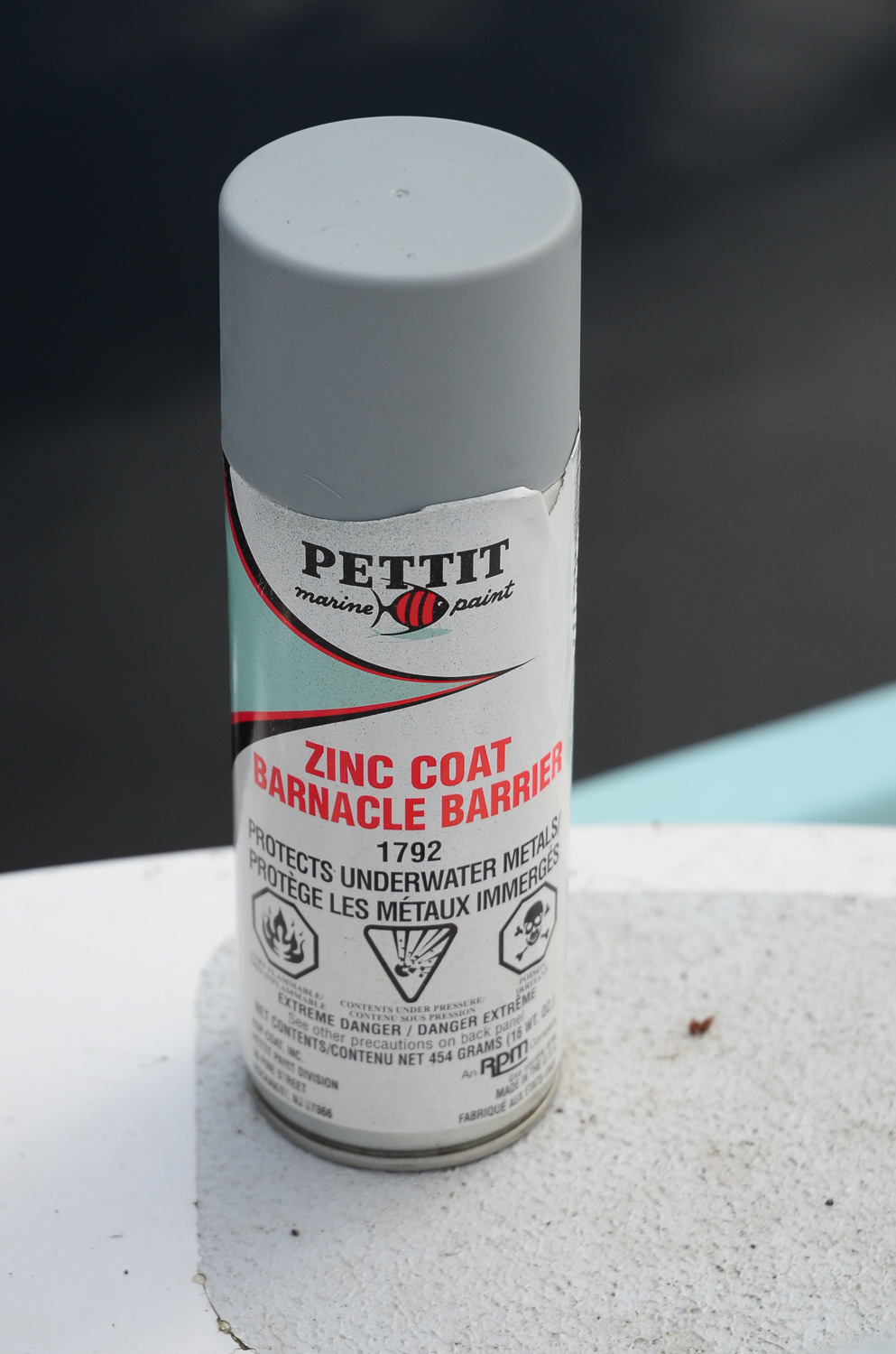
Applied as a spray, Pettit claims Zinc Coat Barnacle Barrier will protect propellers from barnacle build-up.

I still haven’t figured out why the bronze propeller on my boat is the first thing to become encrusted with barnacles after a haul-out. After all, the main constituent of bronze is copper, and my Pettit Horizons antifouling is loaded with copper and it does its job very well elsewhere. But propellers are generally left bare, probably because modern ablative coatings wouldn’t last long due to the high velocity flow across the spinning blades.

Strictly speaking, my prop is probably a manganese bronze which really makes it a brass. Are you confused yet? Well, a brass is an alloy primarily between copper and zinc, typically with 60% copper. True bronzes are usually an alloy of copper with silicon or (now less common) tin. Brass is an inexpensive alloy and very easy to cast into intricate shapes. Unfortunately in a marine environment brass is very susceptible to corrosion and that’s one reason why a small amount of manganese is added. The zinc and copper are not a homogenous mix. Zinc rich areas are electropositive relative to the copper rich areas and consequently zinc dissolves from the surface by electrolysis in the zinc rich areas.

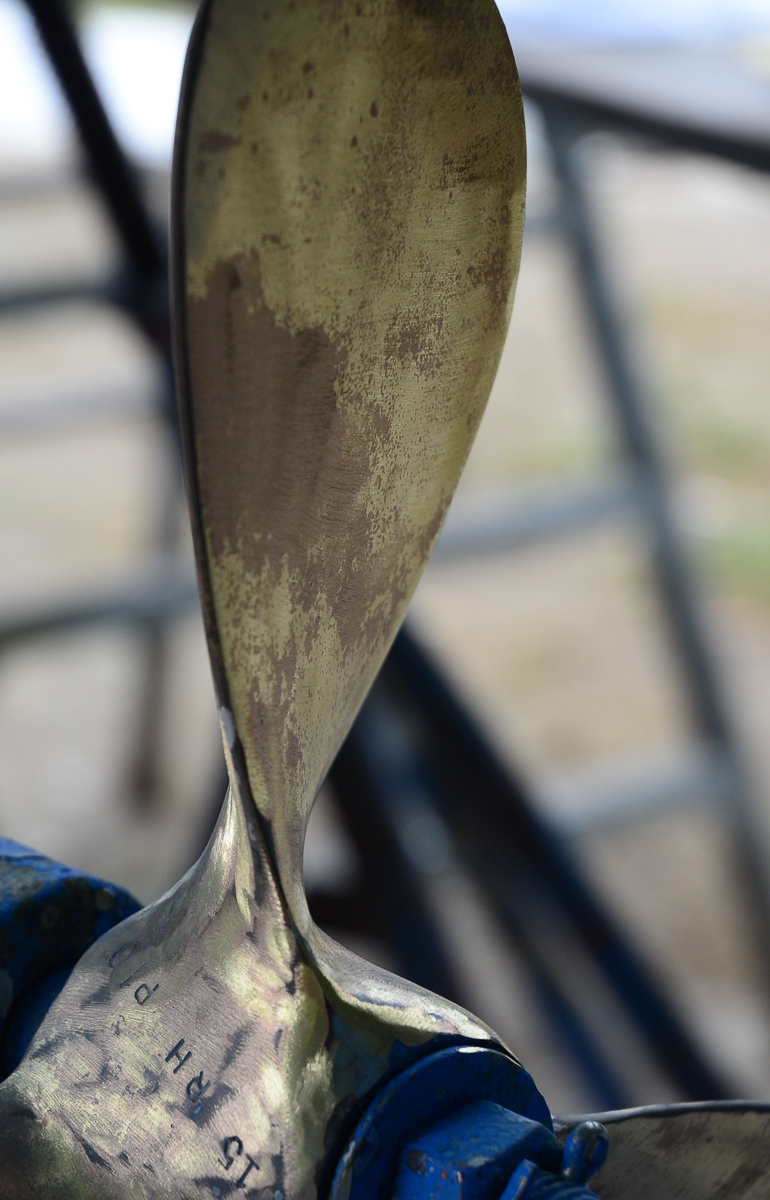
If your freshly polished propeller has a blotchy pink appearance than it is likely to have already suffered some “dezincification.” Some of the zinc has gone leaving a weak, spongy copper rich areas. This can eventually lead to structural failure. That’s why propellers should have some form of galvanic protection, typically in the form of a zinc anode attached to the shaft.

Rainbird's propeller shows signs of dezincification.

Rainbird’s propeller shows signs of dezincification.

In spite of these areas being copper rich, they are still prone to marine fouling, which is perplexing. Perhaps copper in antifouling is just more readily available to prevent fouling.

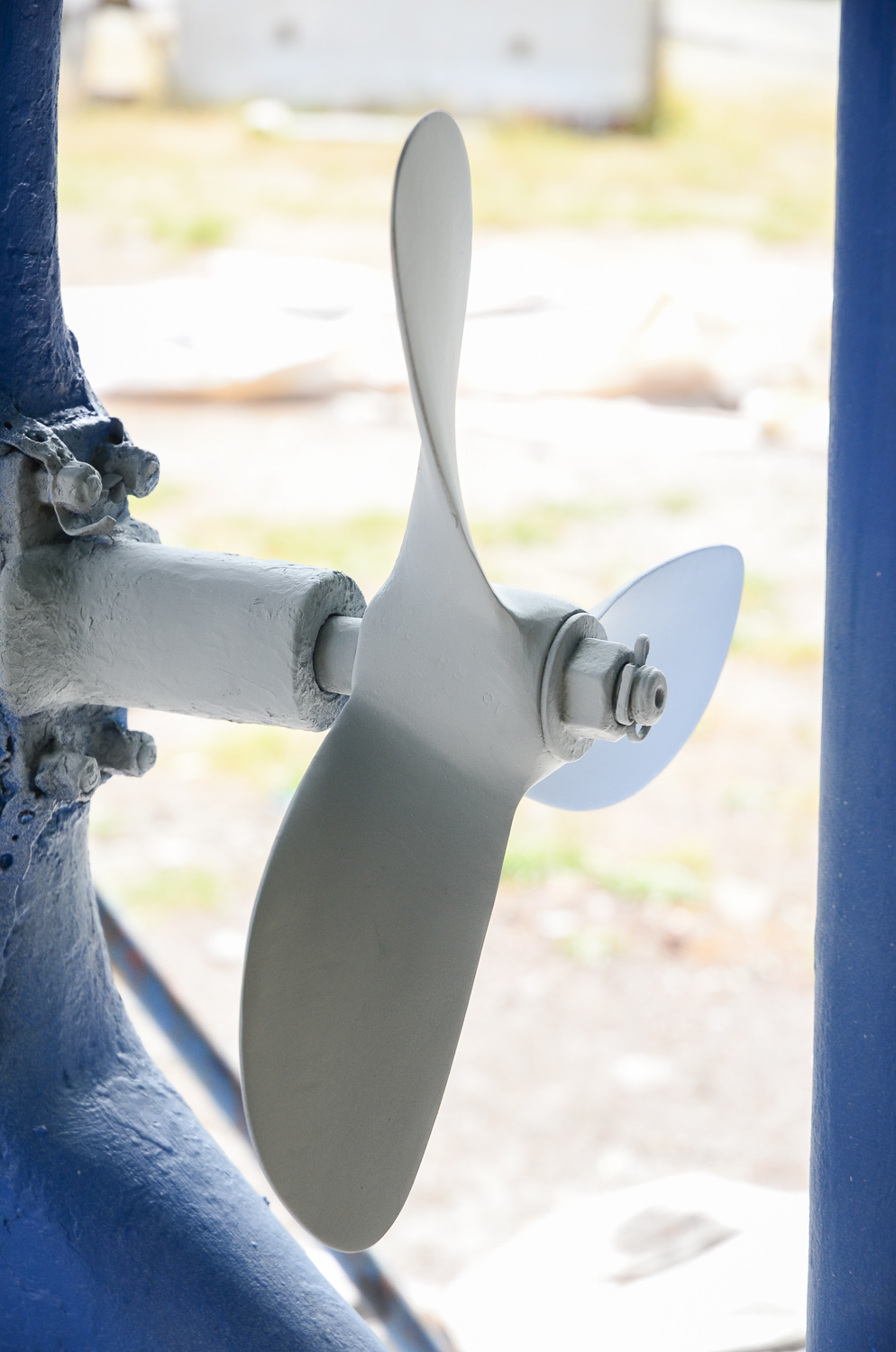
I normally polish the propeller with a fine abrasive and leave it untreated. At a recent haul-out, the boat yard suggested that I try Pettit’s Zinc Coat Barnacle Barrier to prevent barnacles growing on my propeller. This comes in a spray bomb and the instructions recommend 3 coats applied one hour apart. This is easy enough. So why would zinc work as an antifouling? The zinc in my prop obviously doesn’t do the job so why should I expect this to work? Once again, maybe it’s availability, and as the yard pointed out, when was the last time I had seen fouling on a zinc anode?

Time will tell if this is an effective solution and I’ll keep you posted.


Ready for launch; Rainbird's propeller after three coats of Zinc Coat Barnacle Barrier.

Ready for launch; Rainbird’s propeller after three coats of Zinc Coat Barnacle Barrier.