Archive

Tag Archives: Cowichan Bay Maritime Centre

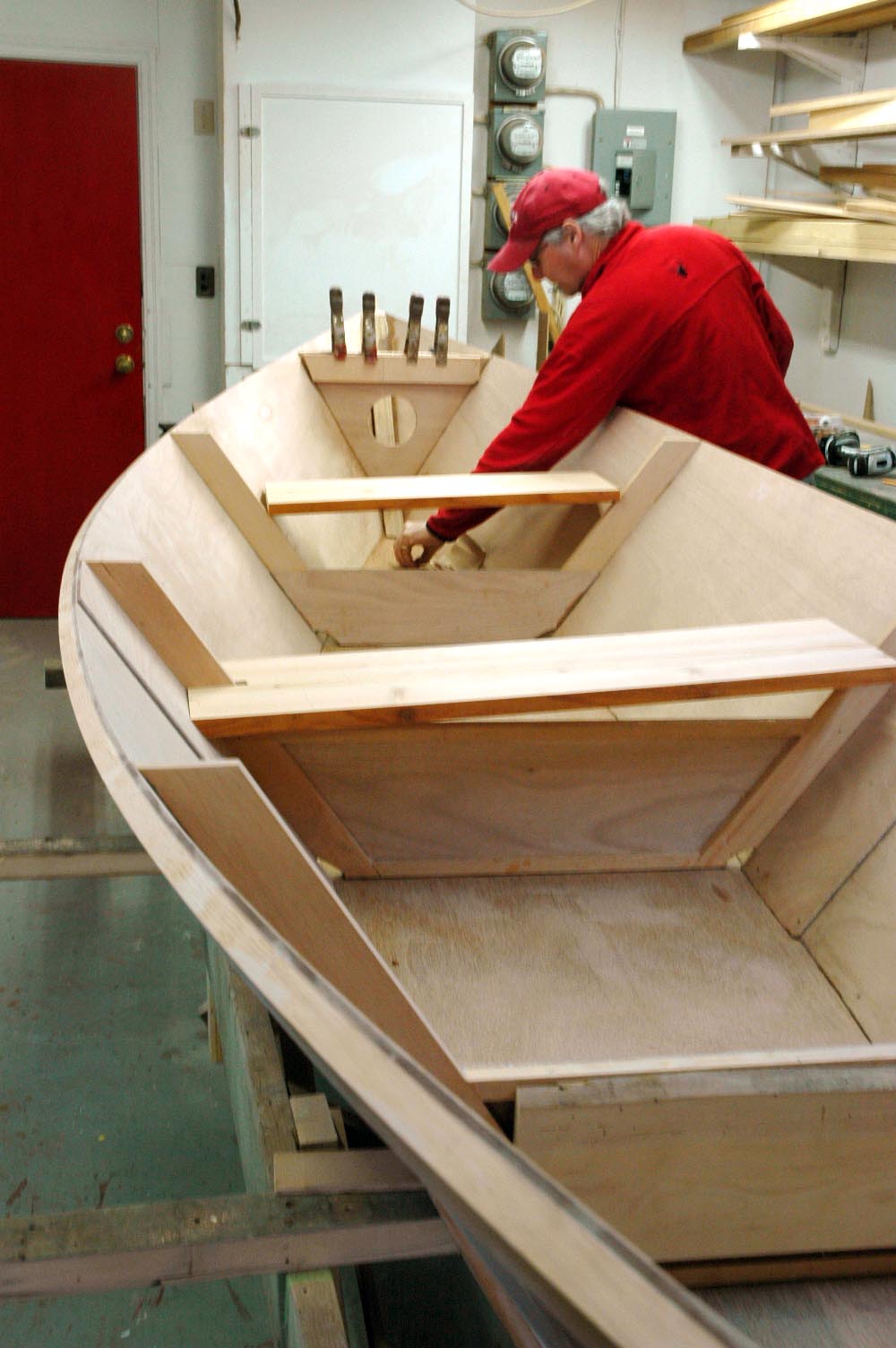
Once turned over, fitting out begins with the thwarts.

By David Skelhon

Much progress has been made since the last post in the middle of January. We now have something that fully resembles a boat and just requires final fitting out and painting.

The external chine logs where fitted before the 9mm plywood bottom was attatched. These are somewhat unconventional and Bolger wrote in his notes accompanying the drawings, “The external  chine log seems slightly easier to fit than the conventional  type, leaves a cleaner interior, adds a minute amount of stability, which certainly needs anything it can get; I don’t think it increases resistance but I can’t prove it yet.”

The chine logs were given a rounded profile on one edge with a router before fitting.  They were tapered a little at the ends where they meet the bow and stern, then, together with the bottom, given a protective layer of 9 oz. glass cloth and epoxy which wrapped around them, cut at the hull sides.

The exterior hull sides were given 3 coats of epoxy to seal the plywood and give a surface ready for paint.

An oak skeg was shaped and glued to the bottom after glassing and radiused fillets made to beef it up against side-loads. No fastenings were used.

Oak cutwaters were roughly shaped on the table saw. These were somewhat oversized and were held in place with copper boat nails and pieces of rope until the epoxy set. They were trimmed flush with a block plane and a grinder with an 80 grit disk. Sounds simple but in practice the fairing process took longer than I imagined could be possible, with the oak and epoxy being tough to cut. The plans don’t call for these cutwaters but it seemed a good idea to protect the plywood edges in some way.

Brian and I flipped her over just as Shaw Cable TV were at the Centre filming for one of their Western Canada shows. I never got to see it so I don’t know whether we hit the big time!

The surplus ply above the gunwales was trimmed off with a jigsaw and finished flush with a block plane.

Happily, Brian decided to buy the dory and will be taking care of the final fitting out. He and his wife, Carol, are keen kayakers and enjoy fishing too. After hearing how they pull up crab traps and land halibut from their kayaks I’m sure it will be a lot easier from the dory!

When I’ve had the chance to take it for a row I’ll make a final report.
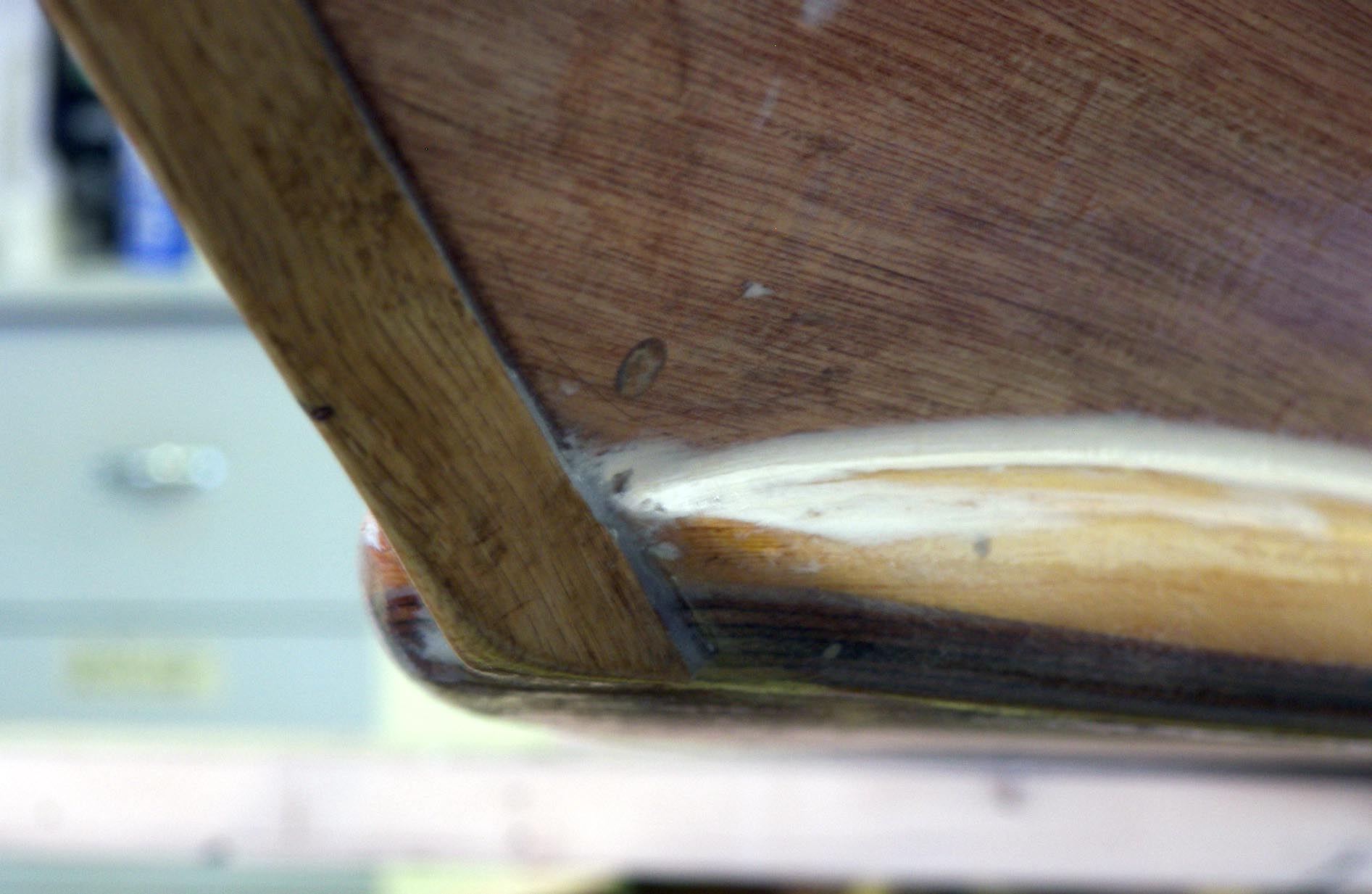
Chine logs and cutwater meet at the bow.
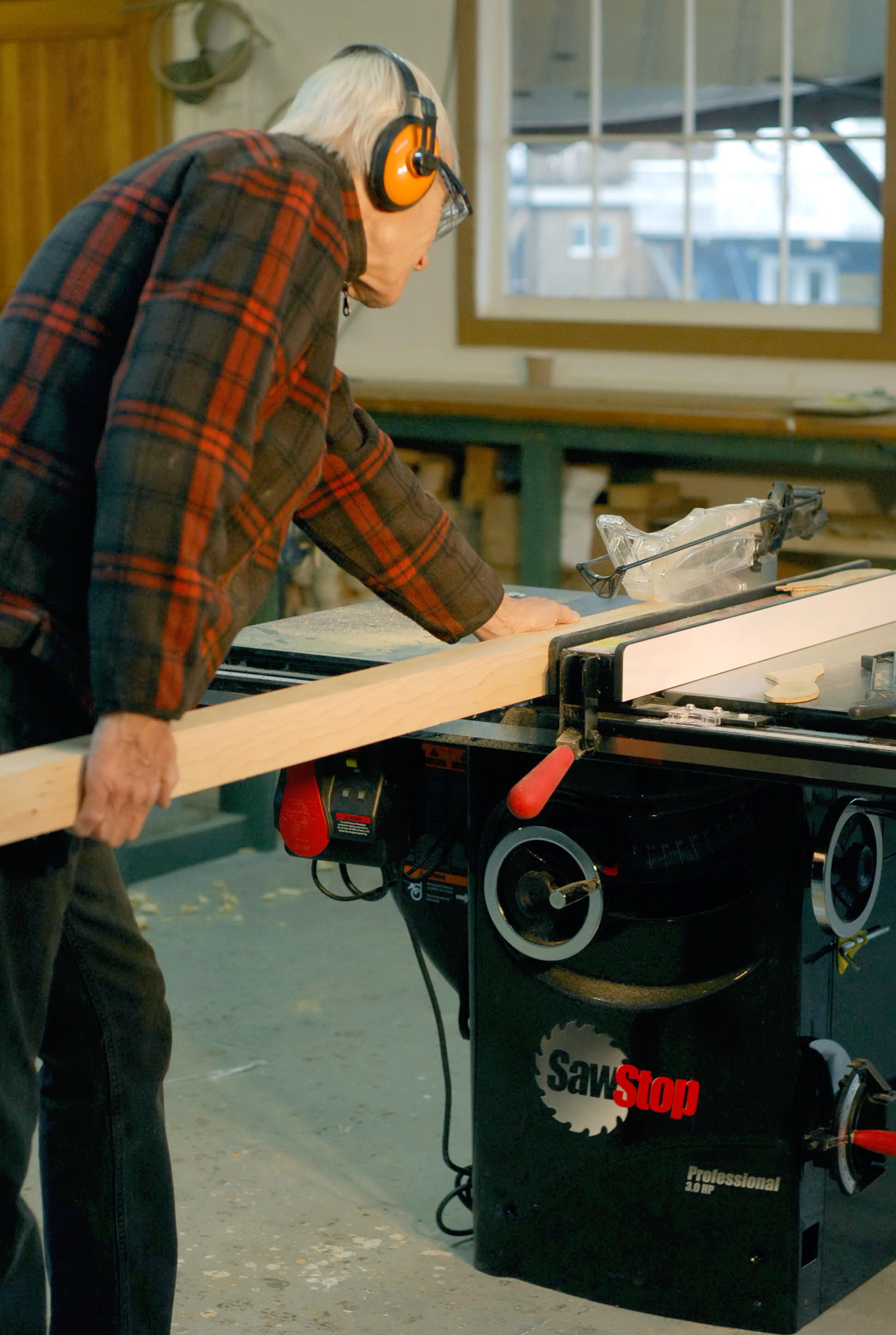
Tony Owen puts some fir through our new saw; SawStop technology helps prevent table saw injuries

We are delighted to announce that we have a new table saw with SawStop technology. This is an important step in improving our member’s safety. We decided it was time to introduce a new “norm” in the way we view safety, especially as we have a wide range of individuals using the shop, from complete novices to seasoned woodworkers.

The table saw is potentially the most dangerous piece of equipment in any woodworking shop and gruesome injuries are not uncommon. There are typically 40 amputations caused by table saws each year in BC alone, plus numerous injuries from “kick-backs.”

WorkSafe BC is quite clear on table saw safety.

“Blade guards on table saws, and to a much lesser degree panel saws, cannot be used in every circumstance. The OHS Regulation allows for the temporary removal of the guard, where its use is impracticable or where the guard itself creates a hazard. The term impracticable means “that which is not reasonably capable of being done.” Impracticable does not mean inconvenient; there should be few situations where it is impracticable to use the guard.

In some cases, however, the guard may physically obstruct the cutting process (for example, when cutting dados or narrow pieces of material). In these cases, the guard may be temporarily removed, but another safety device (or devices) must be used, such as a push stick, push block, feather board, or similar device. Note that the operator’s hands are not an acceptable alternative to a push stick, push block, or similar device. Replace the guard once that cutting operation is completed.”

Returning to kick-backs, consider that the tips of a 10” blade are travelling at around 220kph, and if the blade happens to catch a piece of lumber because you are not using a riving knife, or a guard with anti kick-back pawls, then that piece of lumber is likely to end up heading towards you at 220 kph! I have seen a sliver of lumber narrowly miss a saw operator and then penetrate 2 layers of drywall!

Before using the saw please ask me to show you how the SawStop feature works – important as accidental activations are expensive! I recommend looking at the http://sawstop.com where there is an impressive video on their home page of the technology in action. Basically, if any part of your body makes contact with the blade, an aluminum block is fired into the bottom of the blade, stopping it instantly and retracting it into the table; this all happens in a few milliseconds! You will also find the excellent manual for our Professional Cabinet Saw model at http://www.sawstop.com/support/professional-cabinet-saw/

A hard copy of the manual can be found in the rack just inside the tool room door, together with manuals for the other shop machines. Read it and you will learn a few things – I certainly did. Remember that even SawStop technology won’t protect you from kick-backs if you remove the guards!

The saw was assembled with Collin Craig’s help and we were both very impressed by the build quality of this machine and we are sure you will all find it a pleasure to use.

We have some quality equipment in the shop for member’s use. There are still things we need to improve, and a few more tools that we would like to have (aren’t there always!) and those will come in good time.

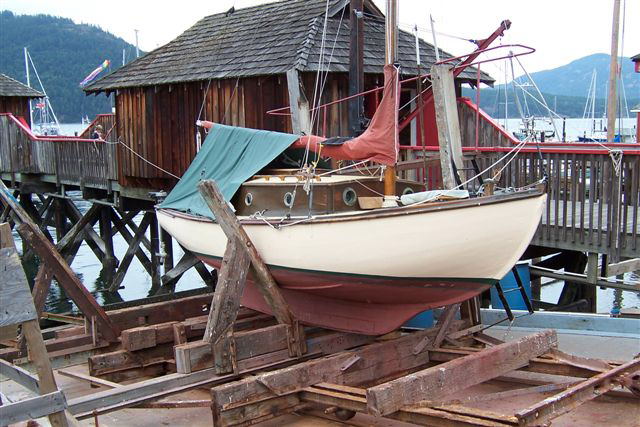
A member's boat is hauled out on the Maritime Centre's ways last year; rebuilding the ways is our major project for 2012.

Our Heritage Ways Are Important For Members And The Local Community

The Covey Marine Heritage Ways is an authentic piece of Cowichan Bay history. Originally built and operated by Ron Lindsay, owner of Covey Marine, these ways are of the traditional railway type design and one of five that operated in Cowichan Bay for many years.

Ron generously donated the ways to the Cowichan Bay Maritime Centre in 2006 and we took on the task of relocating them to our site as part of our interpretive displays. During the move they were brought up to modern environmental standards.

Six years later, after hauling many boats, the ravages of salt water has taken its toll and the complete refurbishment of the carriage is now required. This has also created an opportunity to further improve the ways by increasing its capacity for hauling larger boats. New maintenance services will also be available, including scrubbing, antifouling, zinc replacement plus mechanical and hull repairs.

The ways has become a valuable asset for the Maritime Centre, generating income and providing an important service for boat-owning members. The ways are also important to the local community, bringing in business to stores and restuarants nearby. The cost of the rebuild has been estimated at $25,000 and we are launching a fund raising campaign to achieve that target. If you can help please contact Suzan at cwbs@classicboats.org

Maritime Centre ways operator Lance Underwood has undertaken the task of rebuilding the carriage and with the help of Centre volunteers, the ways should reopen in the early spring.

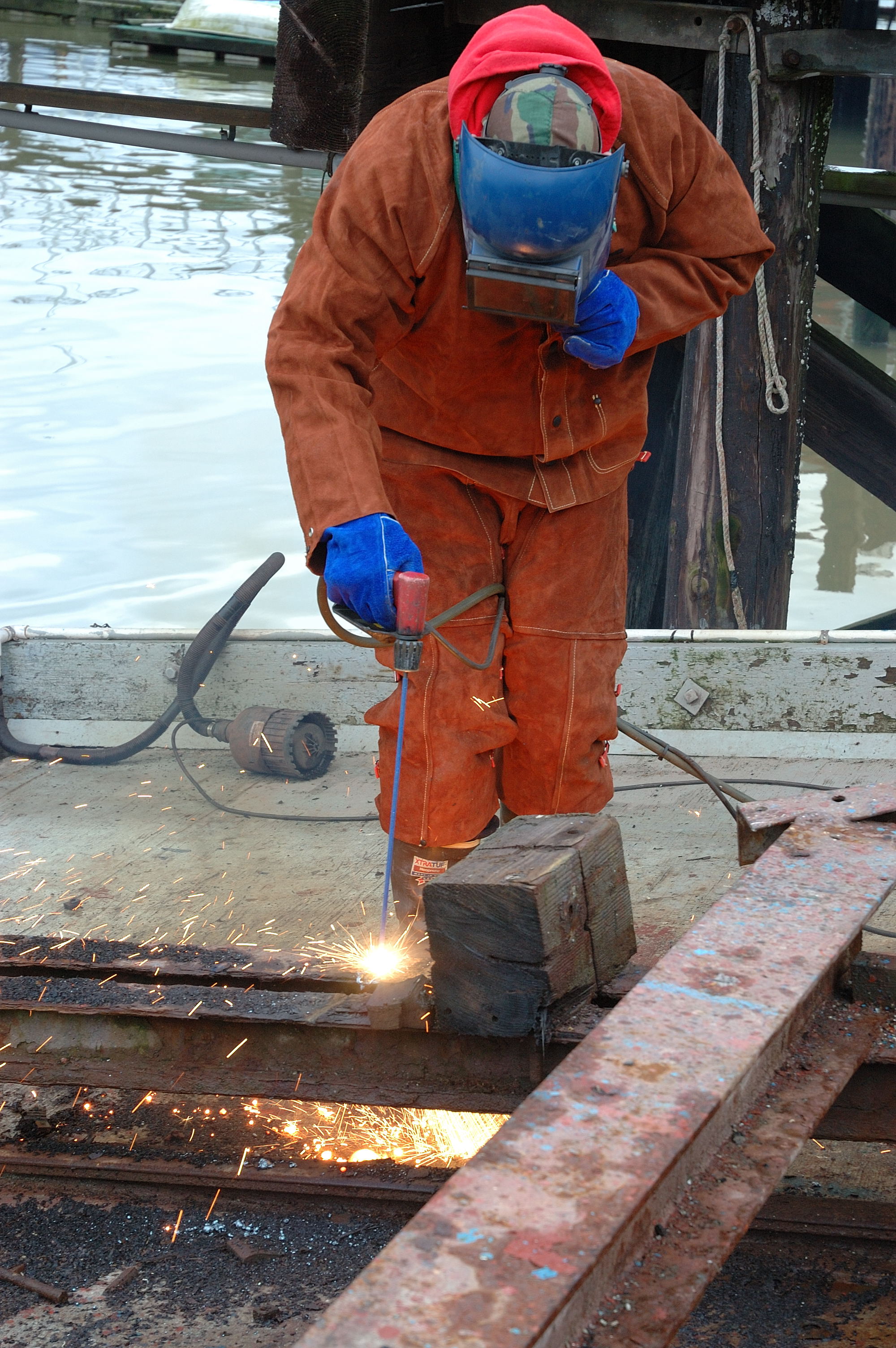
Ways operator Lance Underwood cuts up the badly corroded steel carriage of the old ways.