Archive

Wooden Boats

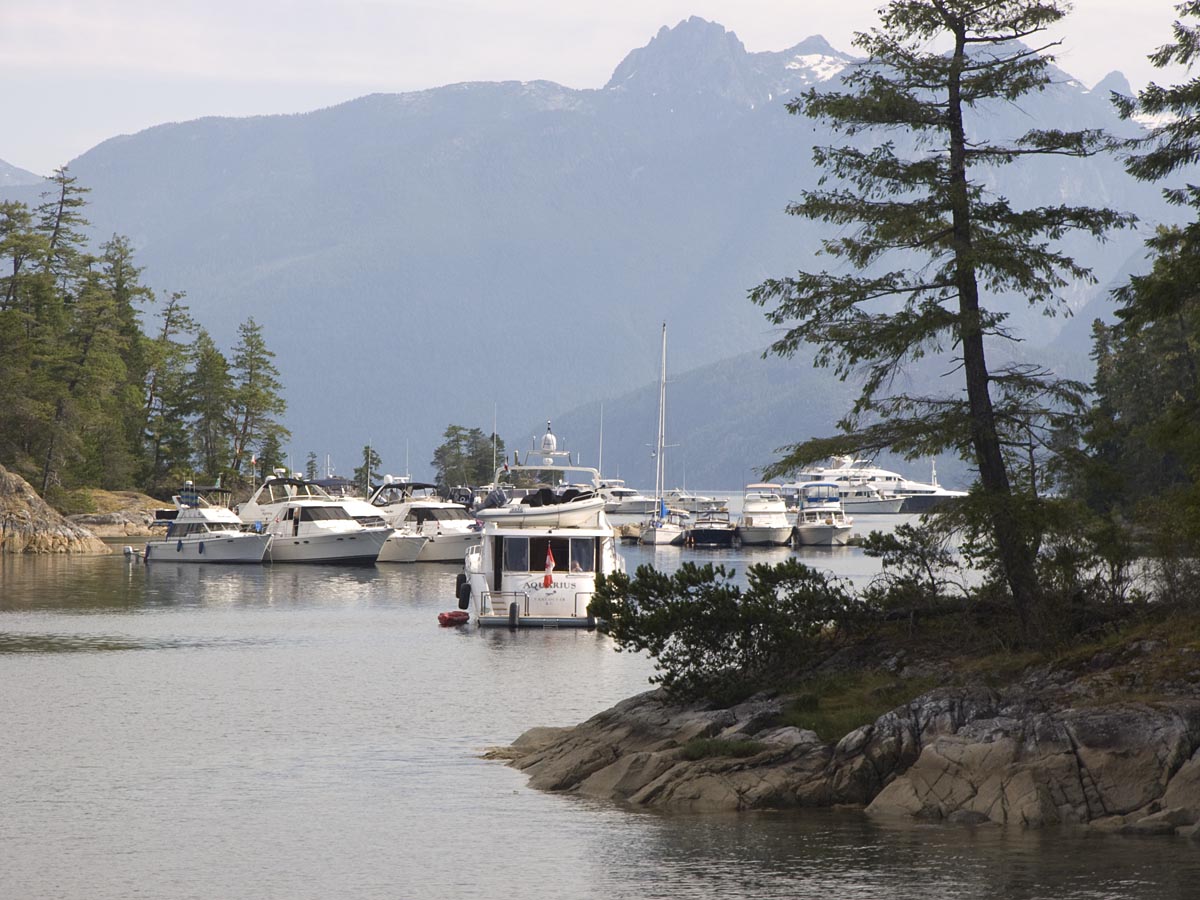
Don’t expect secluded anchorages in Desolation Sound – this is Prideaux Haven in early August.

I had heard that Desolation Sound was “one” of the “Holy Grails” of the cruising world – a must see. Here the salt chuck is warm enough to languish in it for hours without a wetsuit. The summer days are long and balmy and rugged peaks thrust skywards amongst deep channels and cosy anchorages.

After a brief visit this summer I can attest that these facts are true. What is missing from this description of a cruising paradise is the fact that Desolation Sound can hardly be considered desolate when it comes to human visitation.

I’ll admit to being very naïve when I visualised sheltered, secluded anchorages. I hadn’t realised that it is probably one of the busiest yachting playgrounds in the world. The sheer numbers of boats, mainly US registered, and the numbers of very large boats (60′ plus), boggles the mind.

Well, it was August, and a long weekend, but I would guess that the majority of boaters here don’t have to organise their vacations around long weekends.

The sun scorched and the heat and humidity seemed tropical. Thankfully we found relief in the refreshing waters of Melanie Cove by swimming for half an hour while Rainbird was at anchor with a stern line ashore – the standard procedure in these waters to cram as many boats as possible into the tight space.

Power boats outnumbered sailboats by at least 5 to 1 and at one time I saw a raft of 4 substantial power boats being “driven” around the cove in what could have become an insurance assessors nightmare!

Boats came in various shapes and sizes too. A high performance 30 something foot power boat, all engine and very little cabin, anchored beside us. Without a dinghy the stern tie was achieved by backing up carefully to the steep shore and dropping off one of the kids with a rope. Later, dad hung over the stern barbequing supper – where they all slept I have no idea but it was an adventure they will no doubt remember for a long time.

Despite the crowds everyone seemed in good humour, although at times my patience was challenged. Like the time in Refuge Cove where we motored in lazy circles for 45 minutes waiting for dock space that never materialised. We needed some basic supplies and in the end gave up and headed across to Squirrel Cove on Cortes Island. More luck there although I had a last minute fight with a nimble power boat that tried to squeeze in ahead of me just as I was about to step ashore with my lines. Only a quick application of reverse saved the day.

“I have to find a mechanic to fix my boat,” was the excuse provided by the skipper. I very nearly suggested that he should also find himself a fibre-glass technician as he was obviously going to need one if his impatience continued. I pointed to a more than adequate space on the other side of the dock and he zoomed off to take it, leaving me space to take a second run at it.

We got all we needed from the Squirrel Cove Store and by the time our laundry was dry I decided to stay the night on the dock. Good choice, as early the following morning, “Song of Joy”, a very substantial sloop, adeptly squeezed into the space ahead of us. A rather weary skipper explained that it was blowing very hard in the cove during the night and a power boat dragged into them and their anchor rodes became entangled, requiring him to cut his chain to get free.

The power boat was still fouled up and I later saw the skipper flying across the bay in his 30hp centre-console tender to pick up a diver. I don’t know the final outcome but we did spend the following night in the inner cove despite the warning. My wife counted 100 boats before giving up and I saw one raft of 11 boats. That evening, I heard the tannoy of a very large boat, sufficiently loud to alert the whole cove, hail the skipper of a smaller boat in the process of anchoring; “We have 100′ of rode out and when we swing in the night you are the prime target!”
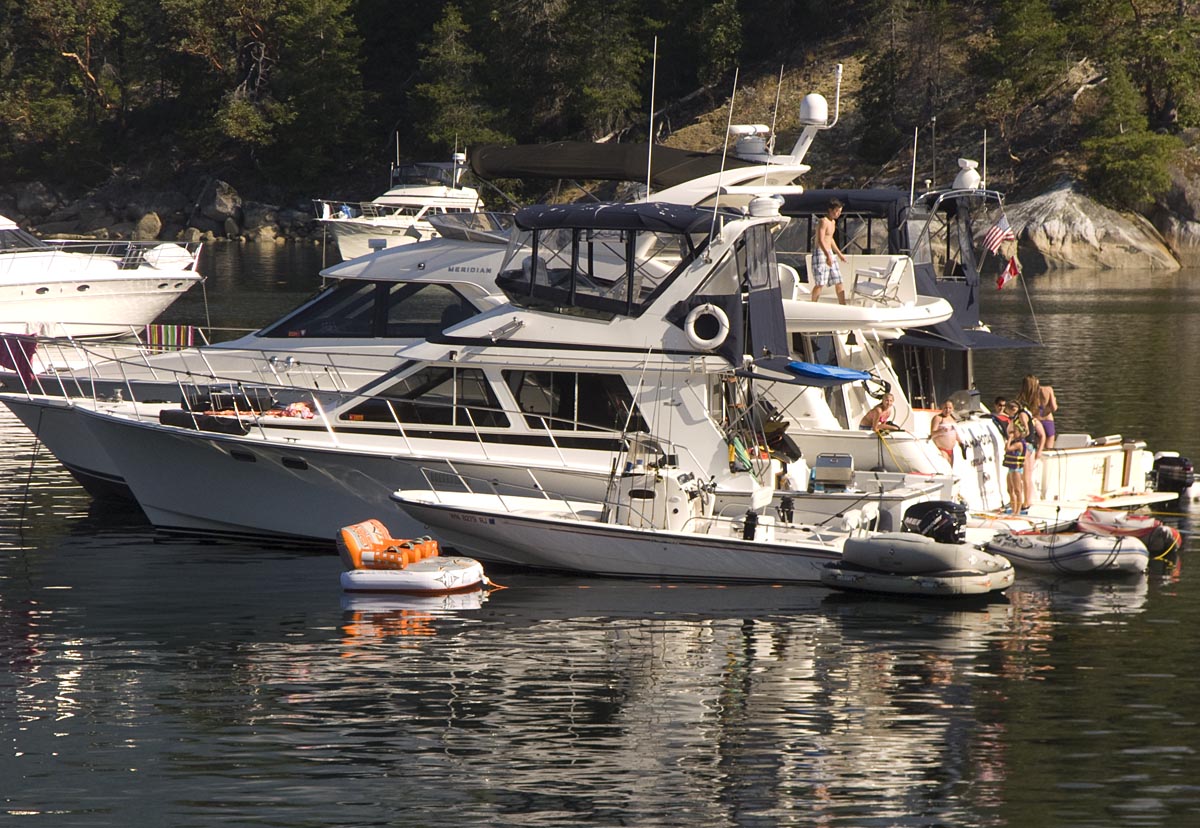
Desolation Sound has become a high-tech playground.

Twenty years ago when I cruised the west coast of Britain in an open-deck Wharram catamaran, I probably saw as many recreational boats in 3 months than I did in a day in Desolation Sound.

The experience has made me question my somewhat romantic notions of cruising. For many, climbing aboard a boat is now like climbing into any recreational vehicle. Engines are fundamentally reliable, the state of the tide can be found on the screen of an iPhone, and with chart plotters and radar, being lost is almost inexcusable. Radar antennas twirl relentlessly and GPS alarms beep and it’s possible to get from Seattle to Juneau without ever donning oil skins or getting a foot wet.

Two or three times daily I rowed our little dinghy ashore so that our Portuguese Water Dog could do what dogs need to do. I only saw two other tenders actually being rowed during the whole two-week trip – the internal combustion engine reigns supreme even when a pair of oars would be perfectly adequate.

In the cold winter months I will ruminate on this experience. In the end I will just probably conclude that the Slocums, Hiscocks and Smeetons of this world are long gone and with them a golden age of cruising. My romantic notions, seeded 25 years ago, are now probably a nonsense.

So do we want to head back up there? The answer is a conditional “yes”. We would do it out of season, when we could drop the hook where seamanship dictated and not where I had to squeeze into a space amongst other boats and would then spend the night worrying where I was swinging. But there is still the lure of the North. The Broughtons beckon – thousands of islands and surely less boats. Failing that, Patagonia perhaps?

Copyright David Skelhon, 2012
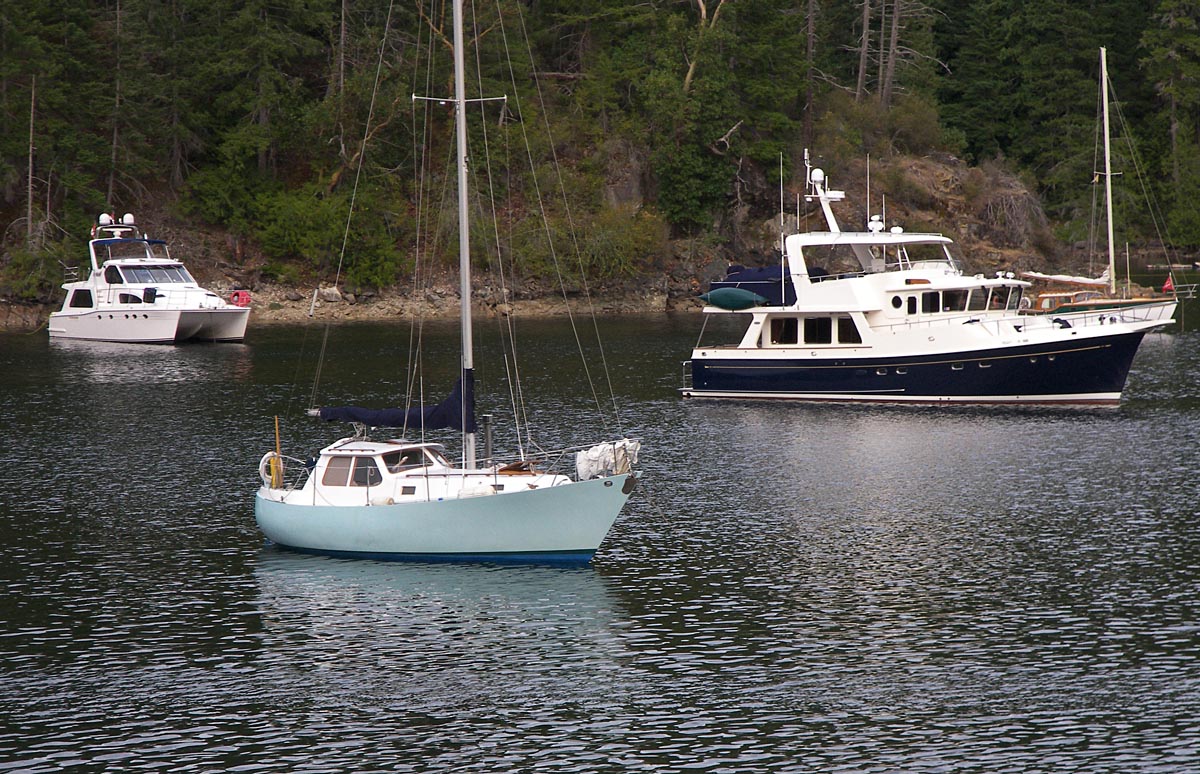
Rainbird at anchor in Squirrel Cove, Cortes Island…..just one of more than 100 boats in the cove.
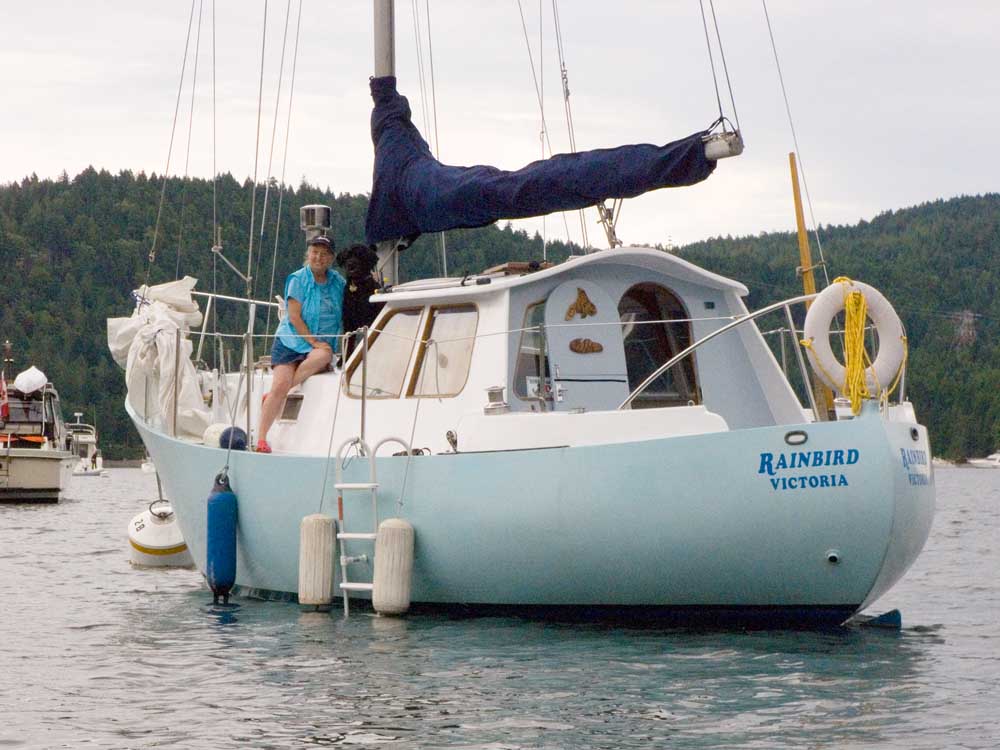
Jilly and our Portuguese Water Dog, Maio, aboard Rainbird in Montague Harbour, BC.

by David Skelhon

Three years ago, my wife, Jilly, bought a 33′ Bill Garden designed, pilot house sloop Rainbird. As far as we can determine, she was built in Canoe Cove on Vancouver Island in the late ’70s by Gerry Anderson. She is cold moulded using red cedar, with fir-ply bulkheads, decks and cabin sides. Her interior is highly functional with ample storage – nothing fancy but built with thought and care as a live-aboard vessel. A Dickinson Pacific stove is the cosy centre-piece, making this an ideal boat for the Pacific North West. Gerry Anderson carried out Bill Garden’s vision to perfection.

Having built several wooden boats and repaired and refitted many others, I am struck with the care, perseverance and passion that builders lavish on their projects. Many are undoubtedly works of art. No two will ever be the same – even when from the same stock design – as each will be imbued with the essence of its builder.

Flip open the latest edition of Cruising World (July 2012) and you will find an inspiring article written by Thies Matzen, about 30 years of adventure aboard Wanderer III. As any sailor worth their salt will of course know, this traditional wooden boat belonged to that most famous cruising couple, Eric and Susan Hiscock. The Hiscocks had this 30′ Laurent Giles design built for them and launched in 1952 and subsequently made two leisurely circumnavigations and wrote the classic sailor’s bible, Cruising Under Sail.

Matzen and his partner Kicki Ericson have since sailed their humble boat both to the tropics and the stormy temperate climes, including a two month trip to Antarctica. Matzen sums up his reasoning for living with this small but capable boat for so long: “As a traditional builder of wooden boats, I like to show such craft aren’t just pretty to look at. They are made to sail too. They are not just romantic but astonishingly functional. Something as basic as Wanderer III, after 60 years and 290,000 miles under sail, is still up for anything.”

Like Wanderer III, Rainbird is astonishingly functional, having been lived aboard for 30 years and cruised extensively in the Pacific North West. I often wonder about the original builder. Putting together a boat like this requires extraordinary vision, dedication, skill, perseverance, understanding from loved ones and of course a big chunk of cash. Had he spent years saving and planning? Was he building full time? Was this the first boat he built or indeed the last? Does he ever wonder where she is or how well she is cared for?

Taking on Rainbird is like being being handed a torch kindled by the designer and brought fully into flame by the builder. As current custodians we have to nurture the flame to illuminate our future voyages of awe and adventure.

Rest assured Gerry Anderson, wherever you are, Rainbird is still loved and well looked after. You did a fine job and it’s appreciated. And, like Wanderer III, she is, “still up for anything.”

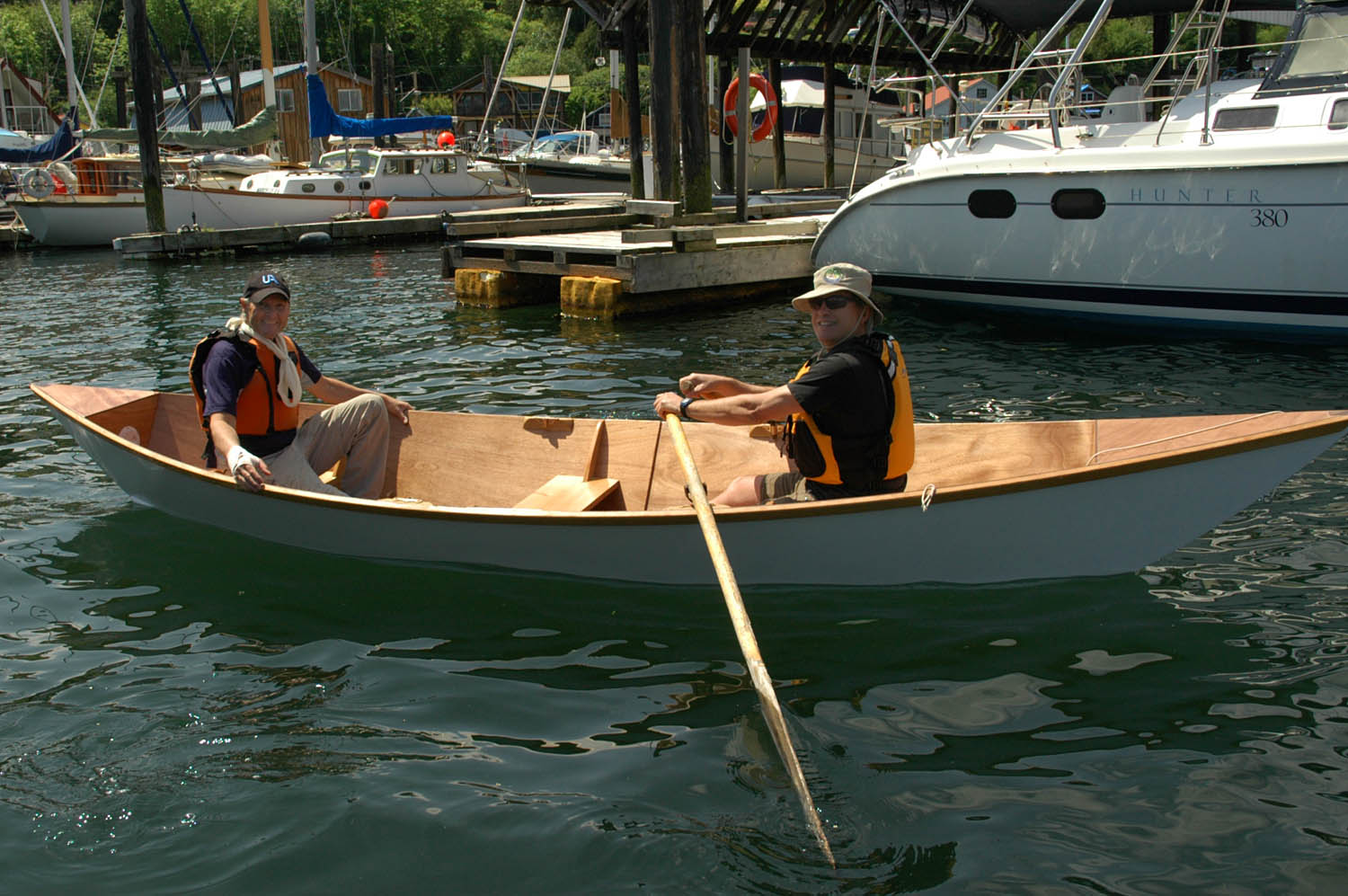
Brian (left) sits back and enjoys his first ride in the newly completed Bolger designed dory while Bob (also one of the course students) rows.

Launch Day Finally Arrives

by David Skelhon

Five months has passed since we first started cutting plywood for the Bolger designed Gloucester Light Dory. As you might recall, much of the initial construction was done by five eager novices on the “Beginning Boat Building Course”. The half-built dory was then purchased by Brian and Carol Elliott back in March and finished by Brian.

I am delighted to report we finally launched her at the Cowichan Bay Maritime Centre on a fine but breezy spring morning and I managed to take her for a quick sea trial. She rows just as I hoped! She is easily driven, has enough skeg for directional stability, and during the brief workout seemed well mannered. A little “tender” for sure, but she was lightly loaded at the time. Weighed down for an expedition I’ve no doubt she would feel rock solid.

Knowing the Elliotts,  I’m suret they will use her to her full potential and I’ll keep you posted.

A dory of this type looks very simple to build and and the techniques involved transfer readily to bigger, more complex designs. Here are a few general tips and recommendations that new builders should take to heart.

 Measure Twice, Cut Once!

It’s been said many times before but it’s worth repeating again. Measure twice and cut once! Well, actually, if you are cutting a complex, 3D component then you are likely to be doing a lot more cutting and fitting than that. Skill and experience are important and there are few tricks and devices to speed things up, but when you are learning the basics it will be tedious and you will screw up from time to time. This boat may look simple but if you have never before fitted, for instance, a thwart, with its beveled and curved ends, you may find yourself scratching your head! Be patient, find a piece of scrap or cardboard to build a pattern first before you cut into that expensive piece of mahogany!

 Getting to Grips With Glues

If you are new to epoxy, read the instructions carefully before you start. With West System, for example, remember to use one pump of resin to one pump of hardener. The mix may be 5:1 for 105 Resin with 205 or 206 hardener, but the pumps are calibrated to deliver that ratio with one pump of each. 207 hardener, which is recommended when a bright finish is needed, has a 3:1 mix. Make sure you are using the correct pump for that hardener!

This may seem obvious but we did at one point have a sticky mess on the boat which was never, ever going to cure  because one pump of hardener had been added to five pumps of resin!

West System’s technical department had obviously heard this many times before and advised using a scraper to remove as much resin as we could and then washing the remainder off with acetone before applying fresh resin.

Please, please remember that uncured epoxy is toxic. I personally know half-a-dozen builders who have become sensitised to epoxy – so much so that they cannot walk into a building where there is uncured resin without experiencing a severe reaction. It is important to add that these users failed to protect themselves adequately, often working for months or years without basic skin protection.

Remember that there are alternatives to epoxy. We used Gorilla glue on most tight fitting joints and it worked like a charm. It’s so easy to use; there is no mixing and measuring, – just squirt it out of the bottle and spread it. Clean up couldn’t be easier, because excess glue foams and can be shaved off with a chisel or knife. It’s cheap compared with epoxy especially when bought in a large bottle. We used it in scarfs, butt straps, frames and the laminated stem and stern. We didn’t use it on the gunwale or chine logs because it was easy to work with slow curing epoxy when accurately clamping long pieces of lumber onto curved surfaces. We also used green painter’s tape on many epoxied joints, pulling it before the epoxy cured, avoiding a lot of difficult sanding later.

Finally, when protecting epoxy with varnish or paint, make sure the epoxy has had chance to fully cure and that any amine “blush” is removed from the surface (a little dilute ammonia solution does this quite well) and then lightly sand the surface. Failing to remove the waxy amine reaction by-product can result in paint or varnish drying very slowly or not at all.