Archive

Tag Archives: Vancouver Island

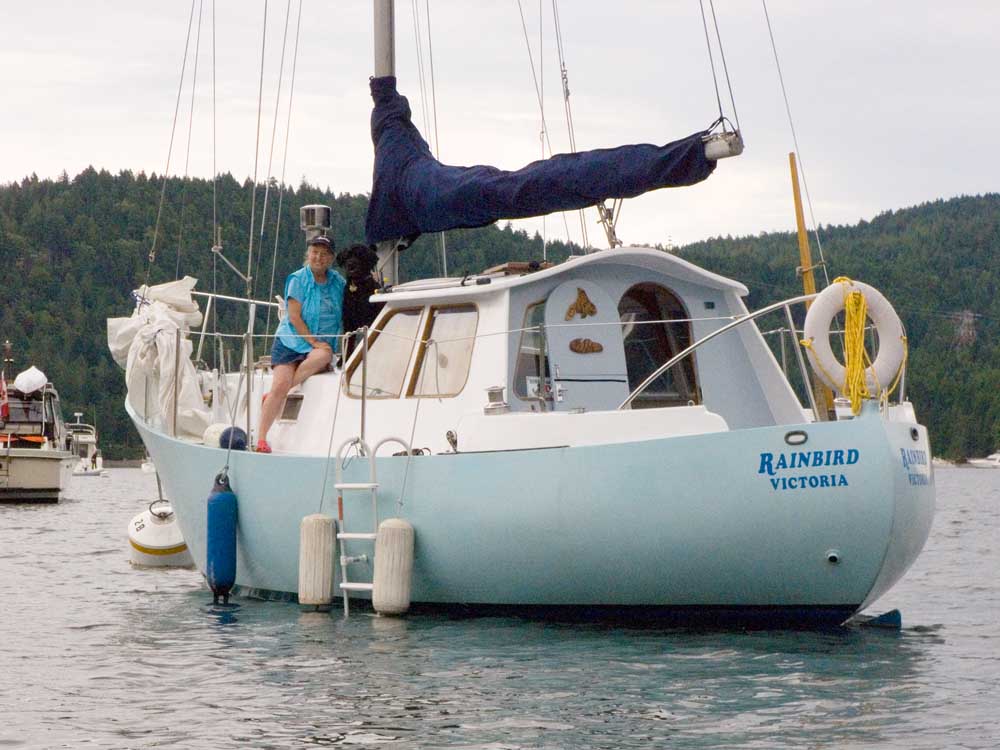
Jilly and our Portuguese Water Dog, Maio, aboard Rainbird in Montague Harbour, BC.

by David Skelhon

Three years ago, my wife, Jilly, bought a 33′ Bill Garden designed, pilot house sloop Rainbird. As far as we can determine, she was built in Canoe Cove on Vancouver Island in the late ’70s by Gerry Anderson. She is cold moulded using red cedar, with fir-ply bulkheads, decks and cabin sides. Her interior is highly functional with ample storage – nothing fancy but built with thought and care as a live-aboard vessel. A Dickinson Pacific stove is the cosy centre-piece, making this an ideal boat for the Pacific North West. Gerry Anderson carried out Bill Garden’s vision to perfection.

Having built several wooden boats and repaired and refitted many others, I am struck with the care, perseverance and passion that builders lavish on their projects. Many are undoubtedly works of art. No two will ever be the same – even when from the same stock design – as each will be imbued with the essence of its builder.

Flip open the latest edition of Cruising World (July 2012) and you will find an inspiring article written by Thies Matzen, about 30 years of adventure aboard Wanderer III. As any sailor worth their salt will of course know, this traditional wooden boat belonged to that most famous cruising couple, Eric and Susan Hiscock. The Hiscocks had this 30′ Laurent Giles design built for them and launched in 1952 and subsequently made two leisurely circumnavigations and wrote the classic sailor’s bible, Cruising Under Sail.

Matzen and his partner Kicki Ericson have since sailed their humble boat both to the tropics and the stormy temperate climes, including a two month trip to Antarctica. Matzen sums up his reasoning for living with this small but capable boat for so long: “As a traditional builder of wooden boats, I like to show such craft aren’t just pretty to look at. They are made to sail too. They are not just romantic but astonishingly functional. Something as basic as Wanderer III, after 60 years and 290,000 miles under sail, is still up for anything.”

Like Wanderer III, Rainbird is astonishingly functional, having been lived aboard for 30 years and cruised extensively in the Pacific North West. I often wonder about the original builder. Putting together a boat like this requires extraordinary vision, dedication, skill, perseverance, understanding from loved ones and of course a big chunk of cash. Had he spent years saving and planning? Was he building full time? Was this the first boat he built or indeed the last? Does he ever wonder where she is or how well she is cared for?

Taking on Rainbird is like being being handed a torch kindled by the designer and brought fully into flame by the builder. As current custodians we have to nurture the flame to illuminate our future voyages of awe and adventure.

Rest assured Gerry Anderson, wherever you are, Rainbird is still loved and well looked after. You did a fine job and it’s appreciated. And, like Wanderer III, she is, “still up for anything.”
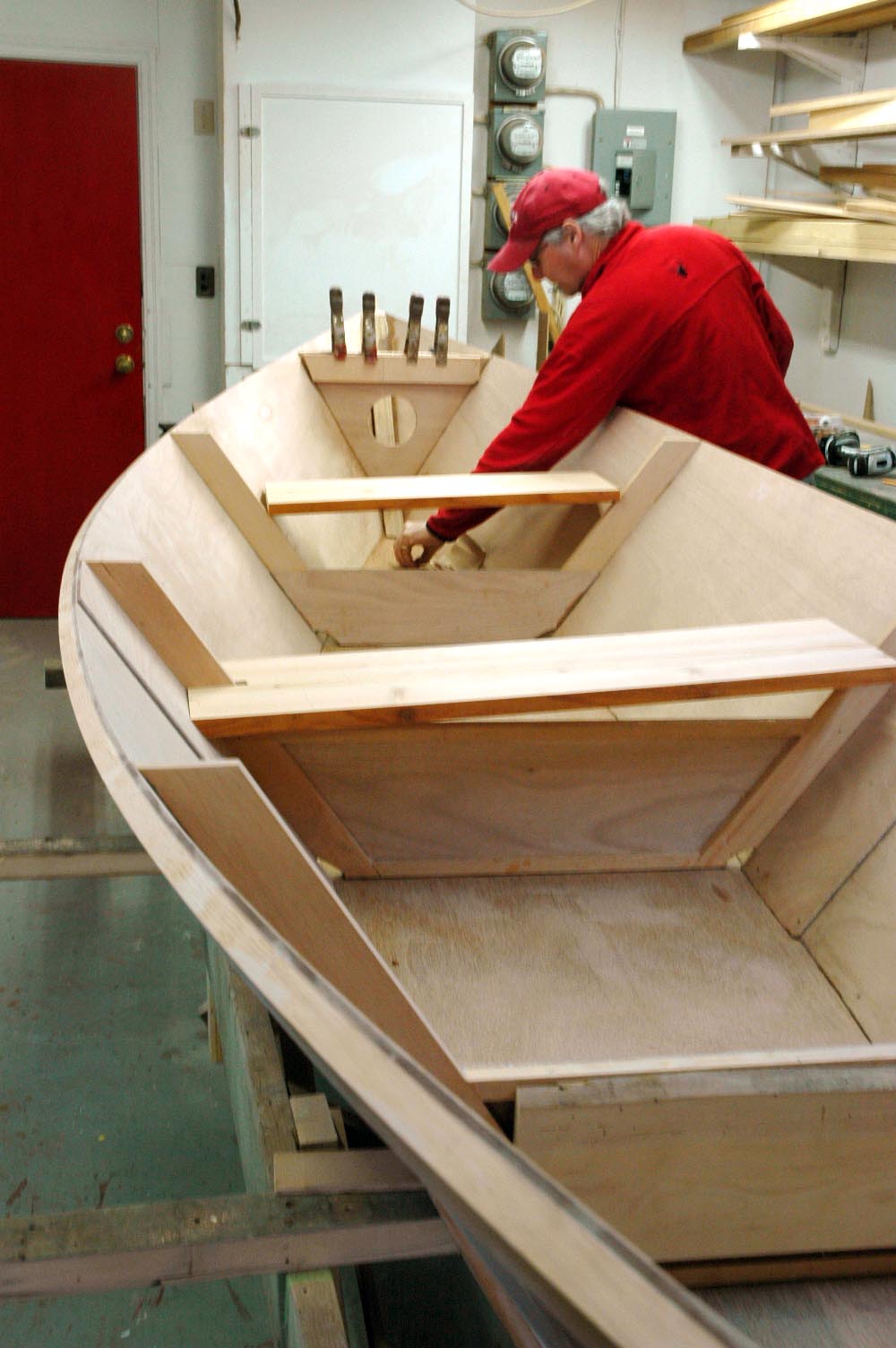
Once turned over, fitting out begins with the thwarts.

By David Skelhon

Much progress has been made since the last post in the middle of January. We now have something that fully resembles a boat and just requires final fitting out and painting.

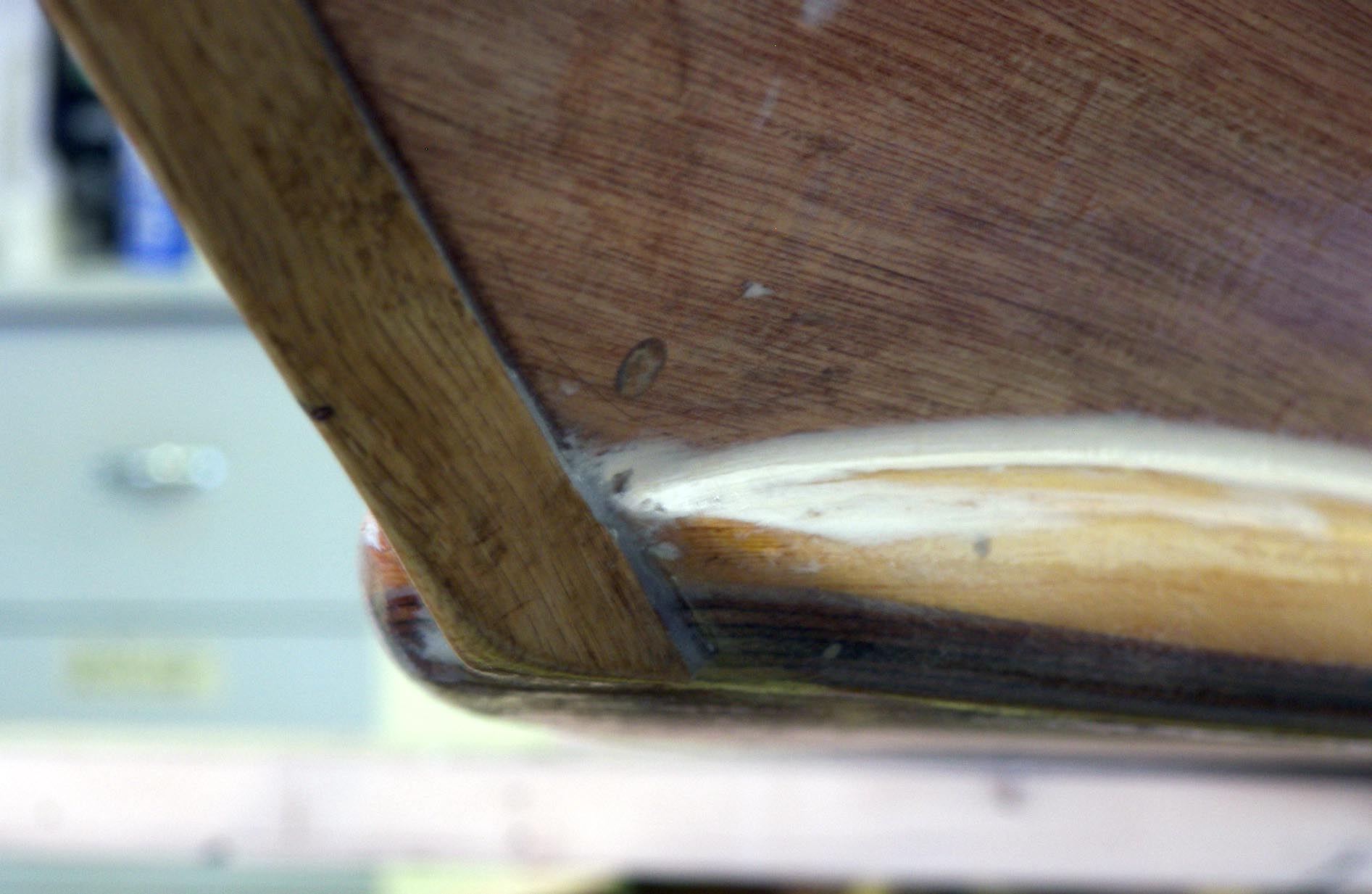
The external chine logs where fitted before the 9mm plywood bottom was attatched. These are somewhat unconventional and Bolger wrote in his notes accompanying the drawings, “The external  chine log seems slightly easier to fit than the conventional  type, leaves a cleaner interior, adds a minute amount of stability, which certainly needs anything it can get; I don’t think it increases resistance but I can’t prove it yet.”

The chine logs were given a rounded profile on one edge with a router before fitting.  They were tapered a little at the ends where they meet the bow and stern, then, together with the bottom, given a protective layer of 9 oz. glass cloth and epoxy which wrapped around them, cut at the hull sides.

The exterior hull sides were given 3 coats of epoxy to seal the plywood and give a surface ready for paint.

An oak skeg was shaped and glued to the bottom after glassing and radiused fillets made to beef it up against side-loads. No fastenings were used.

Oak cutwaters were roughly shaped on the table saw. These were somewhat oversized and were held in place with copper boat nails and pieces of rope until the epoxy set. They were trimmed flush with a block plane and a grinder with an 80 grit disk. Sounds simple but in practice the fairing process took longer than I imagined could be possible, with the oak and epoxy being tough to cut. The plans don’t call for these cutwaters but it seemed a good idea to protect the plywood edges in some way.

Brian and I flipped her over just as Shaw Cable TV were at the Centre filming for one of their Western Canada shows. I never got to see it so I don’t know whether we hit the big time!

The surplus ply above the gunwales was trimmed off with a jigsaw and finished flush with a block plane.

Happily, Brian decided to buy the dory and will be taking care of the final fitting out. He and his wife, Carol, are keen kayakers and enjoy fishing too. After hearing how they pull up crab traps and land halibut from their kayaks I’m sure it will be a lot easier from the dory!

When I’ve had the chance to take it for a row I’ll make a final report.

Chine logs and cutwater meet at the bow.

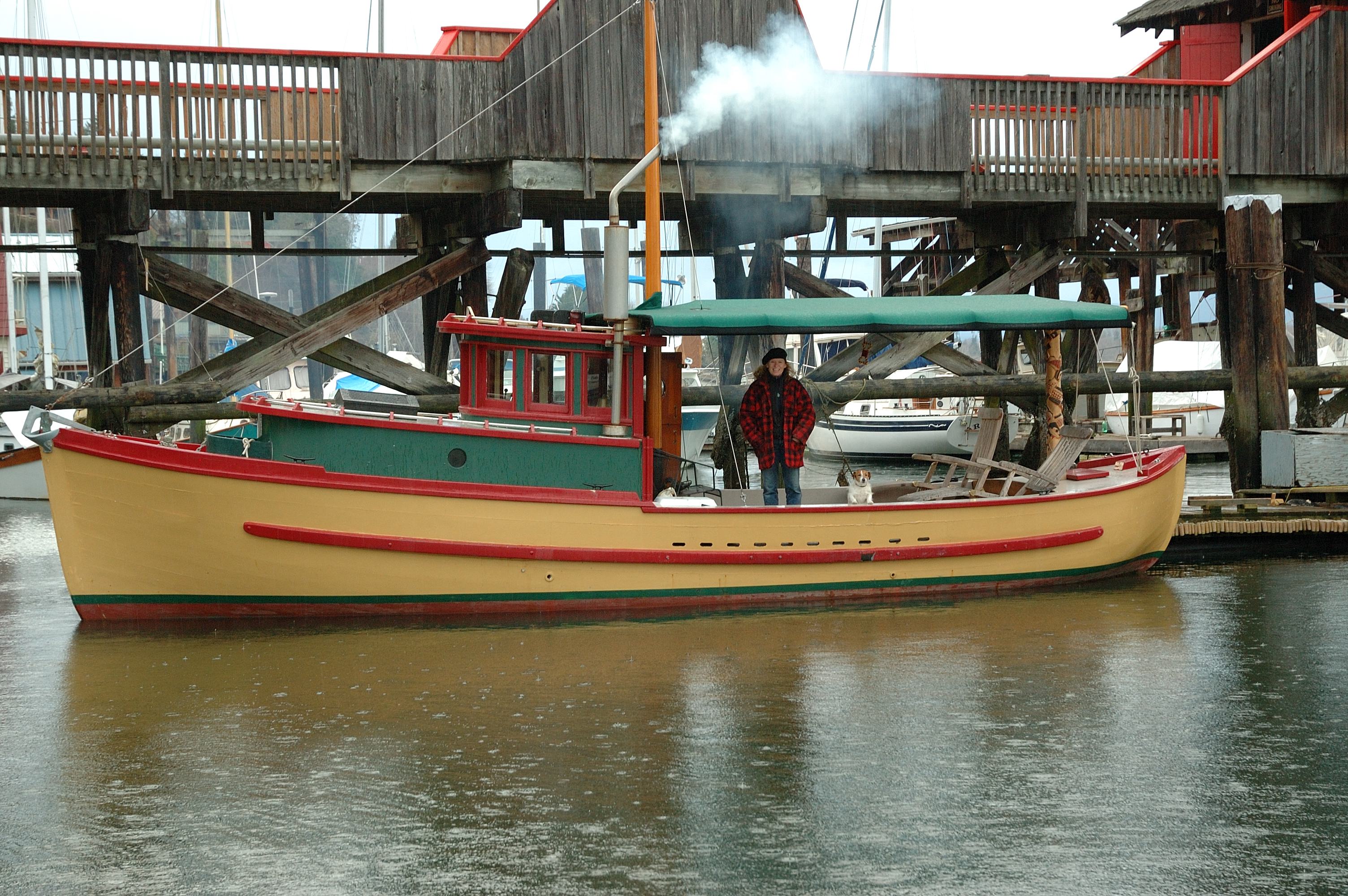
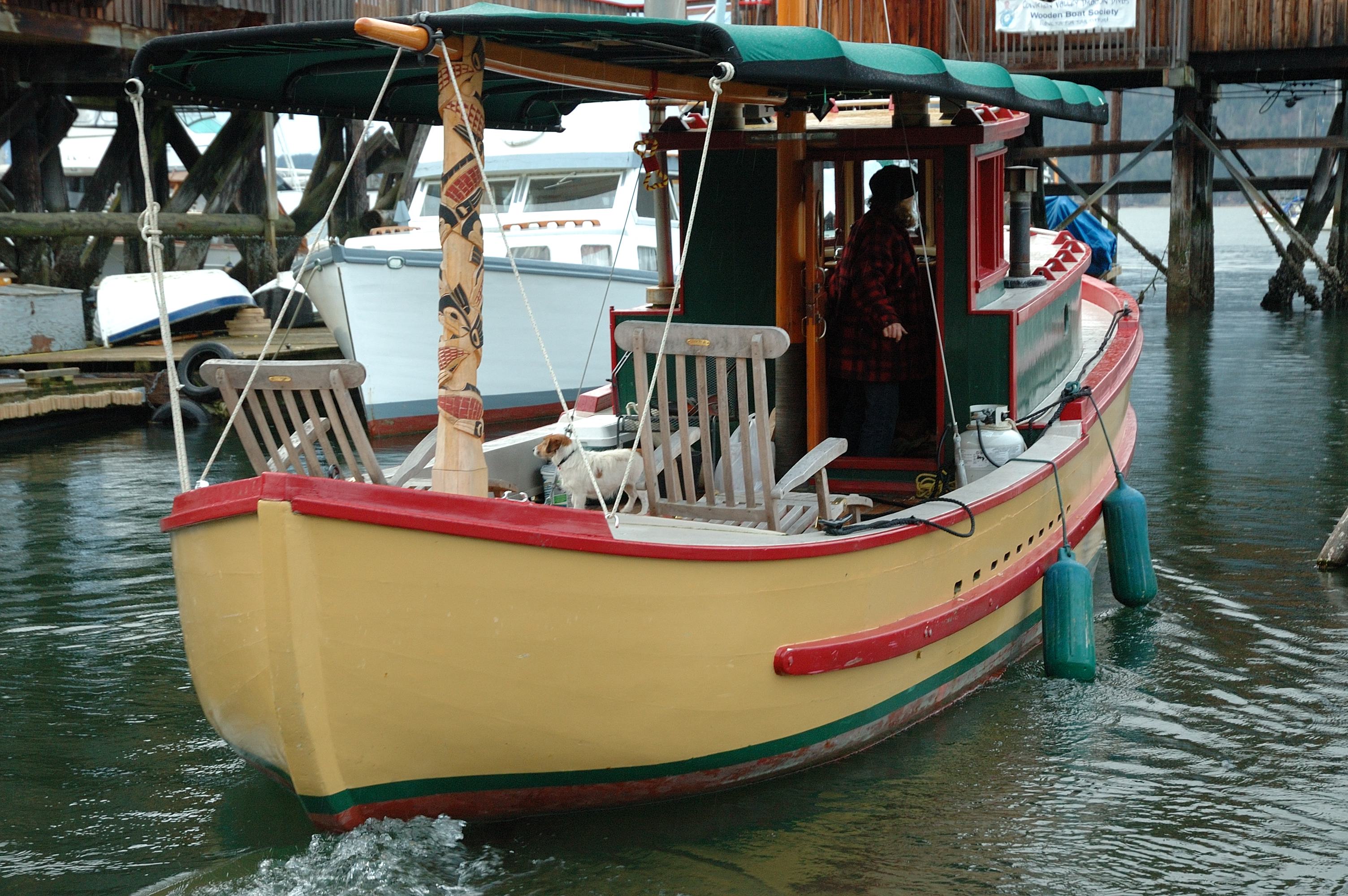
Jan Wylie aboard "Vesta", preparing to depart the Maritime Centre last week.

by David Skelhon

Long-time members of the Maritime Centre may remember “Vesta”, donated to the Centre in 1999 after a long career as a gill netter.

The initial restoration was funded in partnership with Human Resources Canada, as part of a skills training program. She was given new ribs and decks and re-launched in July 2001.Vesta is 32’ long and powered by a 6 cylinder Nissan diesel.  She was used for a time as a “showboat”  by the Maritime Centre, traveling to events along the coast.

Vesta has been owned by local shipwright Jan Wylie for the last 5 years. Wylie said Vesta was built in the ‘50s and used by Jack Jensen and his daughter fishing Porlier Pass between Valdez and Gabriola Islands.

Wylie said she loves the gill netter lines. She considers Vesta a “river boat” and although she has cruised as far north as Princess Luisa Inlet she admits that, after a particularly rough passage, “Thirty-five knots in Georgia Straight was a bit much for a boat of this design!”

Wylie keeps Vesta at Genoa Bay Marina, just across the bay from the Maritime Centre. She has replaced the old steel masts with wooden ones and made an elegant deck awning. She has been busy at the Centre’s workshop this winter making changes to the interior.