Outboard Motor Tips From Tony Owen

Flushing The Cooling System

You have had a super time during the summer and you are going to put your outboard into winter storage, or if you are a saltwater sailor, you may want to keep the keep the rig in the ocean. Either way,  there are some vital parts of your trusty outboard that will need attention.

The first problem that saltwater sailors face is the crystallization of salt in those dark and damp places that are found in marine engines and equipment. The new four-stroke engines are very heavy and are not very portable for service work. An 8 HP four-stroke can weigh upwards of 100lbs, and usually requires the help of another strong back to remove the motor from the dinghy.

All that aside, flushing with fresh water when you are doing your yearly maintenance of the lower-end drive-gear is very important (another Tony tip will be coming about gear oil changing).You can use a simple earmuff device that fixes to the outboard’s lower end or a threaded hose connection available from your engine dealer.
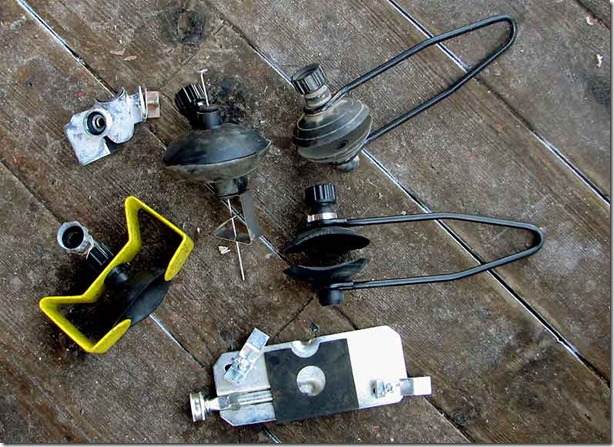
Tony's collection of flushers for outboard motors.

Attach the flushing device, turn on the water and start the motor. Five minutes should do the trick if you have been flushing every year. If there is a problem with the water flow and the motor has been running hotter than usual then put the motor’s lower end in a tub of water containing some off-the-shelf salt deposit remover. Run the motor for 20 minutes so the water in the tub gets warm. This warmed water and salt remover helps to dissolve the salt. Leave overnight and restart in the morning with fresh water in the tub. If this does not help then a workshop manual and some tools may be required. If you don’t know a spanner from a wrench then take the motor to a service depot!

Here is a picture of a motor that had not been fresh water flushed in 5 years. Needless to say this customer’s lower end oil had not been changed either!
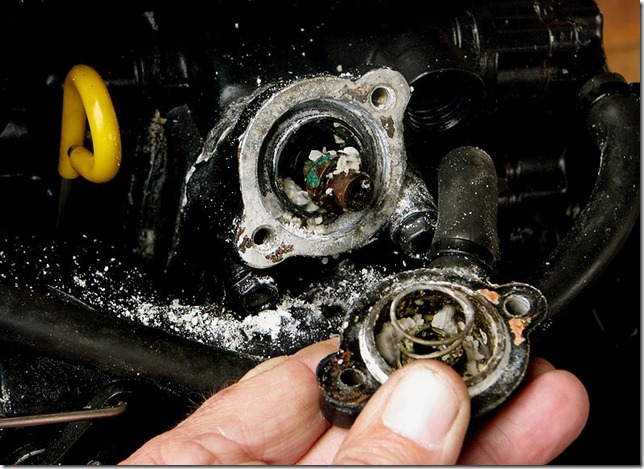
When your motor isn't regularly flushed, salt deposits can build up (seen here in the thermostat housing) and create cooling problems.

The graceful lines of the Bolger designed 15' Gloucester Light Dory (Type V)

By David Skelhon

A rowing dory is a simple, honest boat with enough building challenges for a novice without being over demanding. That’s why we chose the Phil Bolger designed Gloucester Light Dory (Type V) for our beginner’s course as it’s just about as straight forward as it gets.  This model is a “double-ender”, and lacks the traditional dory “tombstone” transom, making construction even easier. Despite its vintage, it’s still a popular boat – no doubt in part due to its reputation for seaworthiness. Just the mention of “Gloucester Light Dory” caused many of our local “salts” eyes to sparkle in recognition.

With five students, we set out to achieve what we could in six, three-hour sessions. Obviously we weren’t going to have a boat on the water at the end of it but with some volunteer input it should be ready for a spring launching.

Victor, our most senior student, has been messing about in boats for years and has built a Bolger dory before.  He is currently building a wee Bolger “”Elegant Punt” as a tender to his sailboat.  The rest of the crew are novices – or at least they were when they started!

I had a couple of weeks head start with the drawings and having built an Iain Oughtred designed Black Fish Dory some 25 years ago as my first boat, I had a good idea how it would go together.

Tobias and Guy started cutting old boards down to size for the strong-back which was a project in itself. It was well done and we shall eventually dismantle it and keep it for the next one.

Bob and Victor started lofting the frames onto a piece of surplus plywood and Brian and I lofted the stem and stern posts. There was a lot of head scratching over the first two sessions; reading drawings is a skill in itself but everyone quickly grasped the principles.  The drawings are beautifully simple and at first sight it appeared improbable that every dimension needed would be there. Of course, from the drawing board of a veteran like Bolger, they were.

One objective was to use Gorilla Glue as much as possible and defer to epoxy whenever we had gaps to fill. Gorilla Glue is very economical to use and because any excess glue that oozes out of the joint rapidly turns to foam, so cleaning up with a chisel or other sharp implement after it has cured is a piece of cake. The boat would be epoxy coated at the end of building to keep it watertight.

We choose 6mm Mahogany marine plywood for the hull sides from our local Windsor Plywood outlet – a very nice 5 ply. To follow the plans and fit plywood seats, 3 sheets are required. We can get the bottom out of one sheet of 9mm ply.

We found enough off-cuts of quarter sawn first-growth Douglas Fir in the basement to make up the frames and purchased a clear 20 ‘ X 4 X 1” Douglas Fir board from Windsor Plywood for the gunwales.

We now have the frames in place and the hull-sides under construction. More details will be posted as the project progresses.

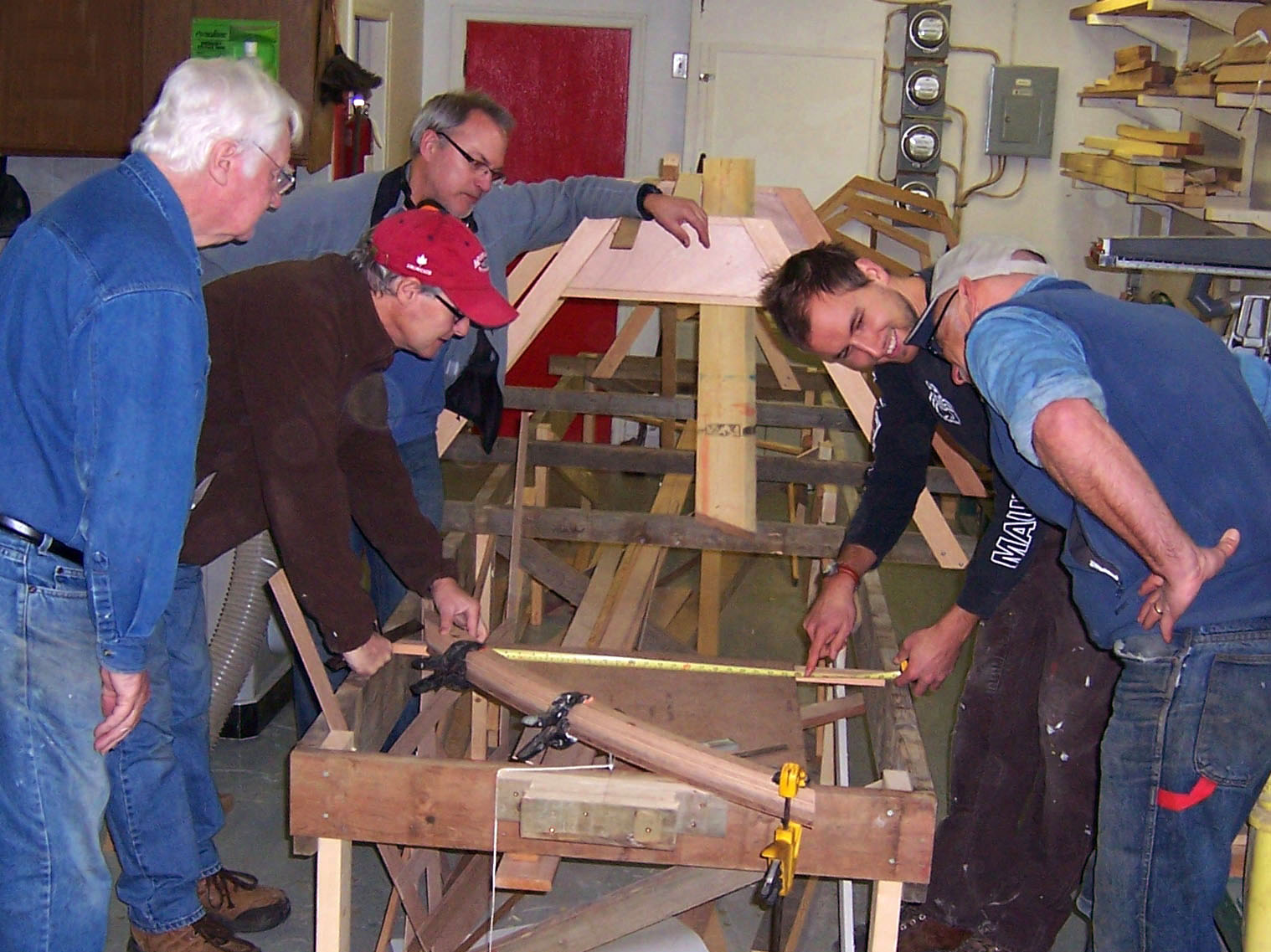
Setting up the stem-post; left to right, Victor, Brian, Bob, Tobias and Guy.