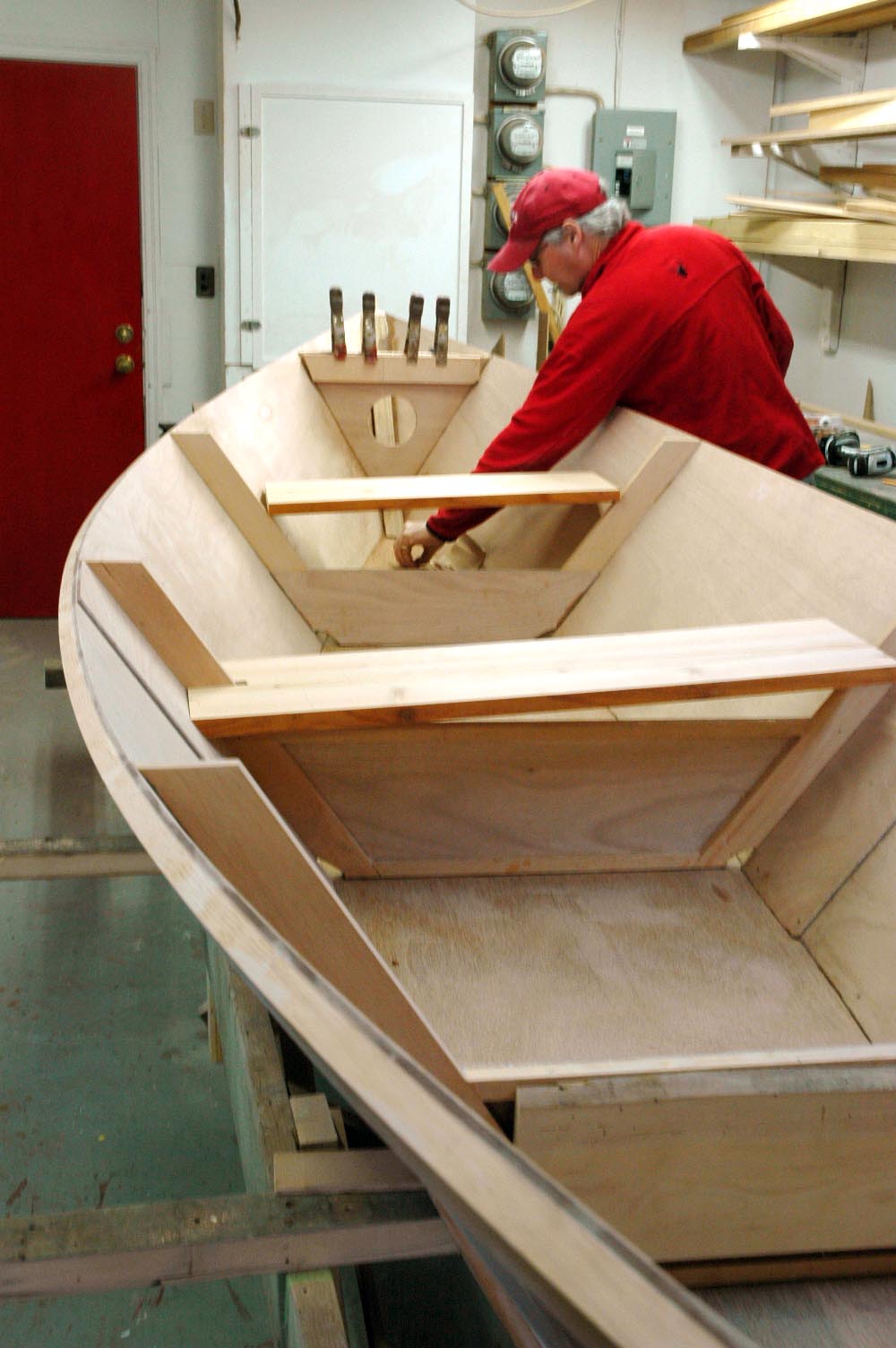
Once turned over, fitting out begins with the thwarts.
By David Skelhon
Much progress has been made since the last post in the middle of January. We now have something that fully resembles a boat and just requires final fitting out and painting.
The external chine logs where fitted before the 9mm plywood bottom was attatched. These are somewhat unconventional and Bolger wrote in his notes accompanying the drawings, “The external chine log seems slightly easier to fit than the conventional type, leaves a cleaner interior, adds a minute amount of stability, which certainly needs anything it can get; I don’t think it increases resistance but I can’t prove it yet.”
The chine logs were given a rounded profile on one edge with a router before fitting. They were tapered a little at the ends where they meet the bow and stern, then, together with the bottom, given a protective layer of 9 oz. glass cloth and epoxy which wrapped around them, cut at the hull sides.
The exterior hull sides were given 3 coats of epoxy to seal the plywood and give a surface ready for paint.
An oak skeg was shaped and glued to the bottom after glassing and radiused fillets made to beef it up against side-loads. No fastenings were used.
Oak cutwaters were roughly shaped on the table saw. These were somewhat oversized and were held in place with copper boat nails and pieces of rope until the epoxy set. They were trimmed flush with a block plane and a grinder with an 80 grit disk. Sounds simple but in practice the fairing process took longer than I imagined could be possible, with the oak and epoxy being tough to cut. The plans don’t call for these cutwaters but it seemed a good idea to protect the plywood edges in some way.
Brian and I flipped her over just as Shaw Cable TV were at the Centre filming for one of their Western Canada shows. I never got to see it so I don’t know whether we hit the big time!
The surplus ply above the gunwales was trimmed off with a jigsaw and finished flush with a block plane.
Happily, Brian decided to buy the dory and will be taking care of the final fitting out. He and his wife, Carol, are keen kayakers and enjoy fishing too. After hearing how they pull up crab traps and land halibut from their kayaks I’m sure it will be a lot easier from the dory!
When I’ve had the chance to take it for a row I’ll make a final report.
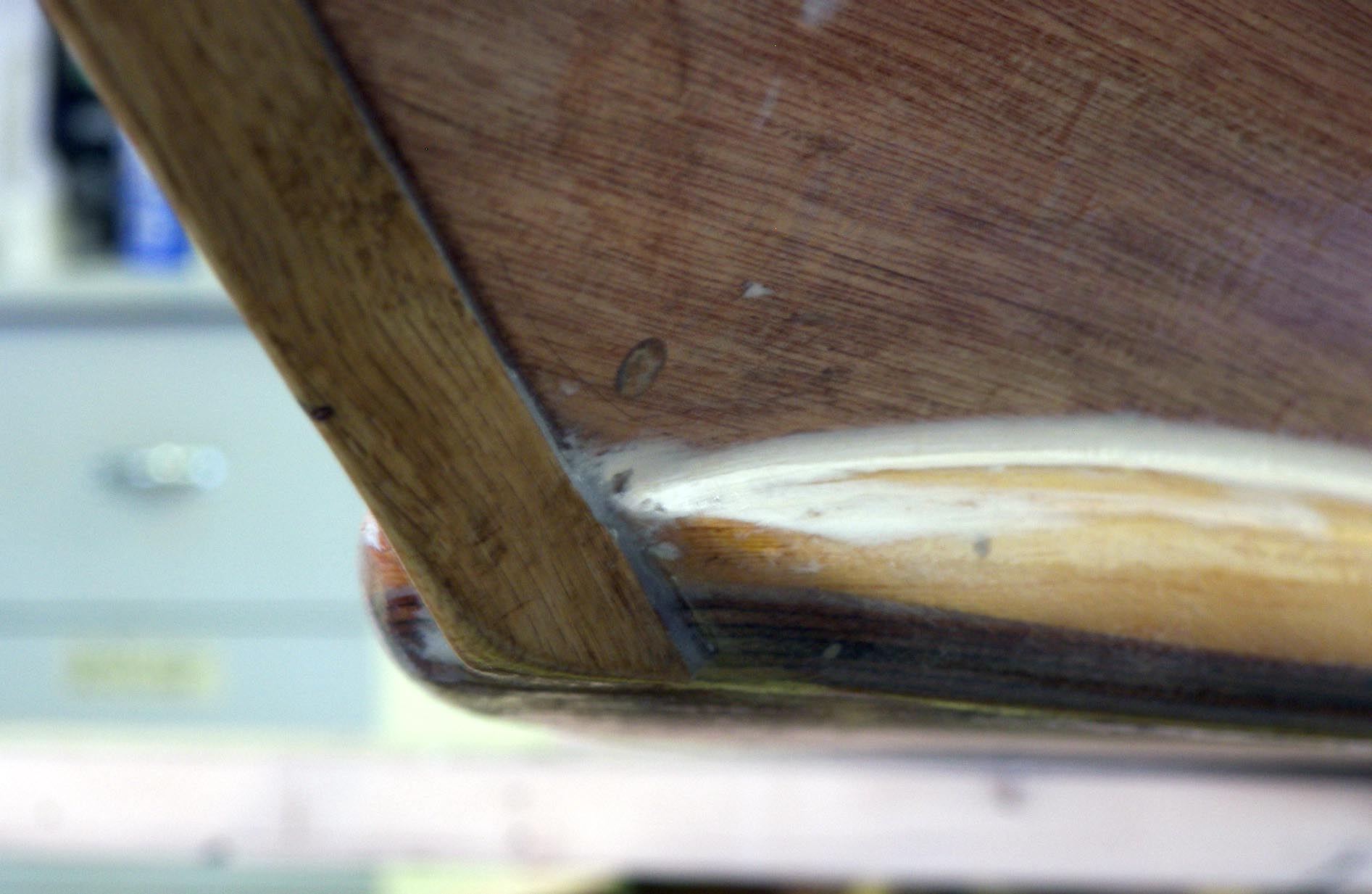
Chine logs and cutwater meet at the bow.
 Pacific Wooden Boats